

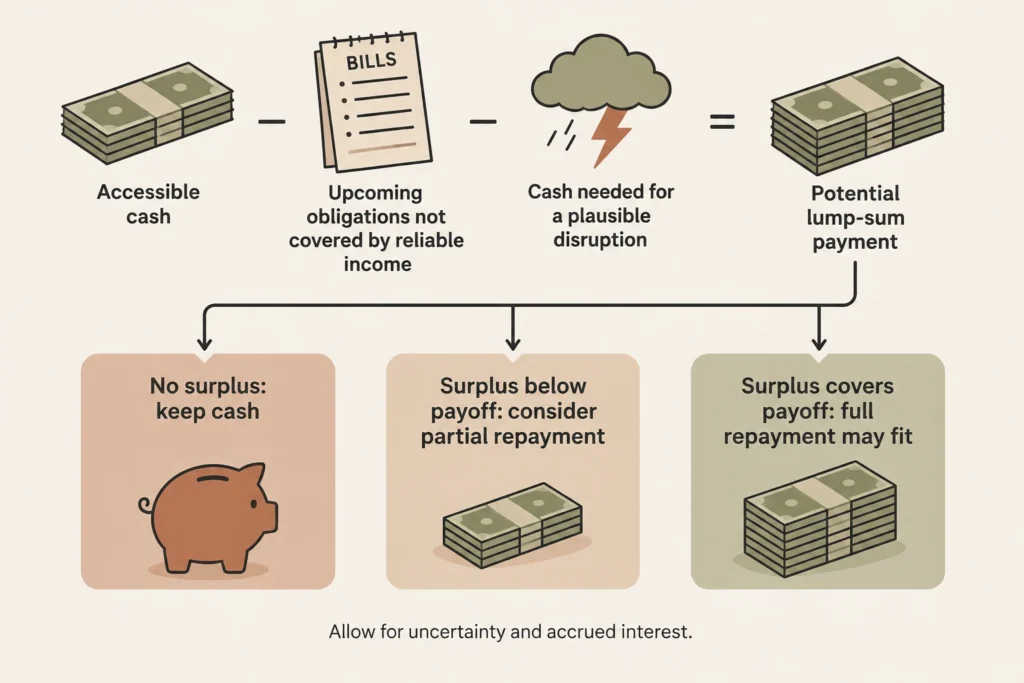
Your emergency savings can be used to pay down credit cards, but only if you have enough cash left over to cover any obligations you may have and if there's a realistic possibility that cash may be disrupted. Leaving bills unpaid to pay down debt is never a good idea. The important distinction is not between savings and debt, but between committed cash and available cash, and cash and credit you may not be able to use.
Find how much cash is actually available
Begin with funds you can easily access in checking and savings accounts. Then subtract pending withdrawals, bills, debt payments, and irregular expenses. Money set aside for an insurance premium next week cannot be used for debt repayment or to meet an emergency. Count each obligation only once, regardless of whether you move money between accounts.
Next, put expected deposits and payments on their actual dates. Having a positive balance at the end of the month does not mean you will never be in the red. The goal is to have enough to meet your obligations and back up expenses, and to do so in a timely manner, not to always meet a particular dollar amount. The CFPB agrees.[1]
Compare the interest cost and remaining cash
For an interest-bearing balance, estimate short-period savings as: payment × applicable APR × days ÷ 365. Many issuers calculate interest daily, so earlier balance reductions generally save more. At 24% APR, a $2,000 reduction saves approximately $39.45 over 30 days. Use the APR for the balance being reduced, not necessarily the headline purchase rate.[2]
Consider a household with $5,000 cash, $1,000 in bills to pay, and a $4,000 balance on a credit card with an APR of 24%. Reliable income covers their normal, ongoing expenses as well as the credit card payments. In this case, $4,000 is available before a lump sum payment. Balances are held constant for 30 days to isolate the effect of the lump sum payment; the calculation does not consider new purchases, fees, payments, or compounding.
| Option | Lump-sum payment | Card principal left | Usable cash left | Estimated interest / savings |
|---|---|---|---|---|
| No lump sum | $0 | $4,000 | $4,000 | $78.90 / $0 |
| Partial repayment | $2,000 | $2,000 | $2,000 | $39.45 / $39.45 |
| Full principal repayment | $4,000 | $0 | $0 | $0 / $78.90 |
Test the cash against a disruption
Two weeks later, a paycheck arrives. With rent due, and the landlord not accepting payment by card, $1,800 in cash is needed, on top of the $1,000 that was already set aside. Full repayment results in a $1,800 cash shortage, partial repayment results in a $200 cash shortage, and no lump sum payment results in a $2,200 cash shortage.
Under those assumptions, $2,200 is the maximum payment that covers the modeled disruption exactly: $4,000 available minus $1,800 needed. Paying $2,000 preserves a $200 margin. Keeping that $2,000 rather than paying it too costs roughly $39.45 in additional interest over 30 days. That is the measurable price of retaining liquidity, not evidence that the remaining cushion is sufficient for every emergency.
If the disruption need is increased to $2,800, the most that can be paid is $1,200 before a cushion is needed. If the need is increased to $4,000, no cash is available as a cushion. For unstable employment or income, consider a longer disruption. Test a scenario where dated balances are rolled over and paid. Reject payment if it means an essential obligation is left unfunded.
What can change the choice?
Backup resources lessen the cash you need to raise only if they are reliable, timely and adequate for the bill. Considered resources include accessible cash, and not hoped-for aid. Card credit is a weaker backup resource. Card issuers may reduce card limits, and card credit cannot fund a payment. A card limit reduction is not a certainty and is not the same as repayment.[4]
Before considering a cash advance as a backup resource, check the terms and conditions and understand when the cash advance fee and interest will post to the account. A cash advance should only be used to cover a payment if the card issuer allows for a full payoff. Cash advance fees are not posted to the card account to clear the balance.[3]
A true 0% APR balance means no interest will be charged on the account; however, repaying the account before the end of the promotional period will not result in savings on interest. Similar to true 0% APR financing, interest may be charged on a deferred-interest financing transaction. Failing to meet the payoff conditions on a deferred-interest financing transaction can result in interest being charged retroactively to the date of the original purchase.[5]
A lump sum payment may reduce interest but does not address the underlying reasons for the shortfall. Continue to pay credit card payments if the payments are affordable; otherwise, request a payment arrangement to postpone the shortfall rather than draining your resources to do so.
Sources and references
- Consumer Financial Protection Bureau: An essential guide to building an emergency fund
- Consumer Financial Protection Bureau: How does my credit card company calculate the amount of interest I owe?
- JPMorgan Chase Bank, N.A.: Chase sample cardmember agreement COL00062
- Consumer Financial Protection Bureau: Can my credit card issuer reduce my credit limit?
- Consumer Financial Protection Bureau: I got a credit card promising no interest for a purchase if I pay in full within 12 months. How does this work?