

You generally don't need to pay before your credit-card statement closes. On an otherwise current account, pay at least the statement's minimum by its due date to meet the payment obligation. If you have an active purchase grace period, pay the full statement balance by that date to avoid purchase interest. Those are two different amounts doing two different jobs.
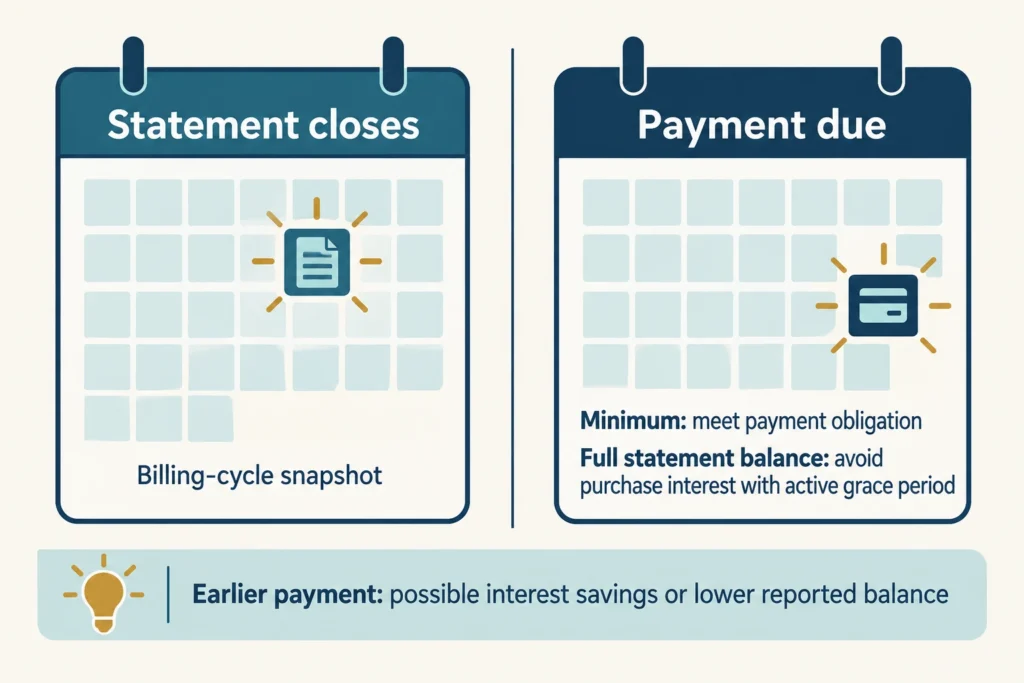
I'd treat an earlier payment as a choice with a specific purpose: reducing interest that's already accruing or lowering the balance reported to credit bureaus. Neither benefit automatically justifies leaving yourself short for groceries or rent before payday. First, let's connect the dates to the bill they actually belong to.
The closing date creates the bill; the due date is its deadline
The statement closing date ends a billing cycle and produces a snapshot of what you owe. That statement has its own payment due date. Meanwhile, the next cycle is already running, which is why your app can show a payment deadline that comes before the next closing date. You aren't being asked to pay a bill before it exists.
To simplify, let’s say your credit card has a purchase only grace period. Also assume there are no fees or adjustments. The $30 minimum payment is just for illustration.
- From September 11th to October 10th you make $600 in purchases.
- October 10th, Statement closes with a $600 balance and a $30 minimum due November 4.
- October 20: An additional $150 of transactions has posted, bringing your current balance to $750. Your October statement balance is still $600.
- October 30: Before the payment deadline, you receive your paycheck.
- November 4: The minimum payment is $30. The full $600 payment is due to avoid purchase interest, given this example’s grace period is active.
- November 10: The cycle closes. The $150 transaction made this cycle belongs to this statement and has a due date in the future if unpaid.
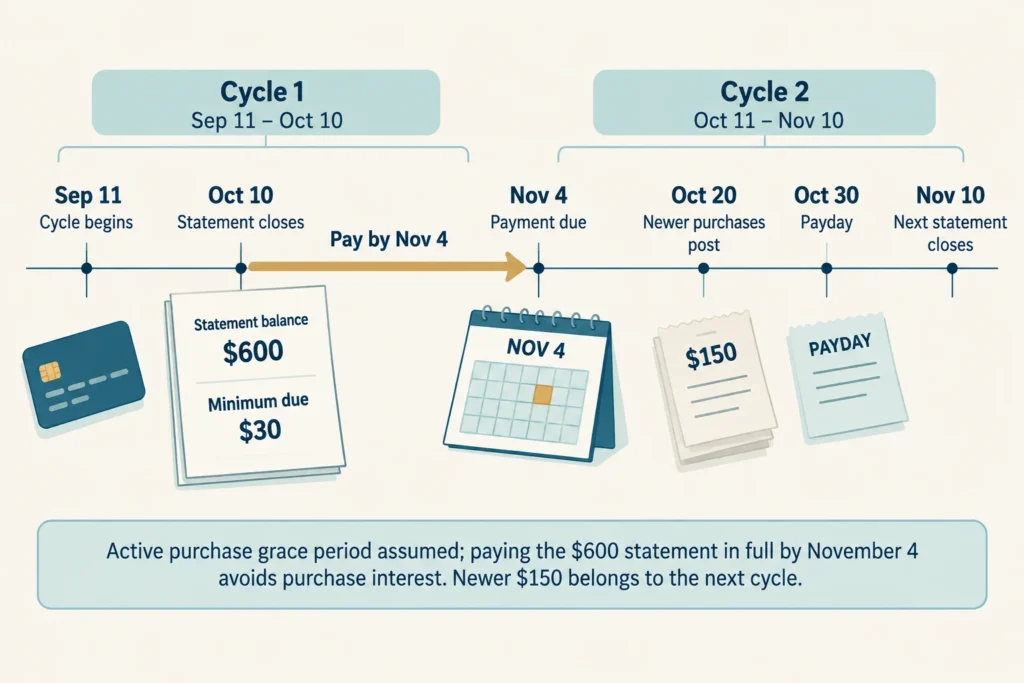
The $150 in the app is not due November 4. The statement balance is from the completed cycle and your current balance is the newer posted purchases. In this example, you would not incur purchase interest on the $600 statement balance if you pay it off. The remaining balance is $750.
Picture me in this example, looking at the $600 statement with $700 in checking and $250 of groceries and utility payments to make before payday. Paying it all immediately leaves $100, a $150 shortage. That zero balance on the card is not looking as appealing. I'd keep the essential cash and schedule the statement payment after October 30, assuming that paycheck can cover it by November 4.
A partial payment would work too. Paying $450 would leave $250 for essentials, and $150 to pay after payday. Based on the active grace period, the $600 payment would result in the same purchase-interest outcome, whether paid all at once or in pieces, as long as the full payment is made by the due date. Paying in pieces is not required.
If you're carrying debt, waiting can cost interest
The important clue isn't simply that your statement shows a balance. It's whether you left part of a previous statement unpaid and lost your purchase grace period. Without grace, new purchases may accrue interest from their transaction dates, even when you pay the minimum on time. Some cards don't offer a purchase grace period at all.
For a balance accruing daily interest, paying earlier lowers the balance for more days. Moving a $500 payment 15 days earlier at 24% APR saves approximately $500 × 0.24 ÷ 365 × 15 = $4.93. That assumes the payment reduces the interest-bearing balance, the APR stays unchanged, and the calculation uses a 365-day divisor. Payment allocation and other calculation details can change the result.
It is worth saving the $4.93 if you have the cash after essentials. Just keep in mind that the savings is from reducing the number of interest-bearing days, not from beating the closing date.
Why interest can appear after you pay off the statement
Paying your statement balance does not guarantee you will not incur interest again. Interest accrued between the time your statement closes and the time your payment is processed may be posted on your next statement. According to an example agreement posted on Chase’s website, one mechanism of how this can happen is described. However, Chase states in its agreement that the mechanisms described do not govern every account.
I would ask my issuer two questions before I consider the debt settled: “What is the amount that settles this balance if my payment is credited on this date, including accrued interest?” and “What payment condition restores my purchase grace period?” Make sure to look for any interest that may have posted to your account on the next statement. Certain rules may differ for cash advances, promotional balances, or installment plans.
A reported balance isn't an interest bill
Credit card balances are typically reported on or near the end of the billing cycle. Your credit report could therefore show the $600 snapshot even after you pay it in full by November 4 and owe no purchase interest. Just because you see the balance does not mean you’ve paid interest.
The credit card company may take a couple of days to update your credit report after you’ve paid it.
Paying your credit card balance early can help lower the balance reported to the credit bureaus before a hard credit check, like a credit application. Credit card companies take a snapshot of your balance to report to the credit bureaus on different dates, and early payments can help reduce your reported balance utilization. This is not something required of you, but can be beneficial in lowering your credit utilization. Discover communicates its reporting cycle near the end of the month, but other card issuers may vary, so it's best to not treat the closing date as a guaranteed reporting date.
Match the payment to your payday
On the closing date, the credit card statement will reflect the new balance due, and provide the minimum amount due. Payment due dates may vary, and you can't always rely on the app to tell you when the next closing date is. You may need to pay the statement balance before the due date.
You will need to pay by the deadline, and this may vary due to the payment method you use and time zone. Sending payment to one bank from another bank may not be immediate. The day may not always be extended for an electronic payment, and not all payment due dates are the same (i.e. not all payments are due on a Friday at midnight).
If you don't pay the minimum due before the due date, you can always contact the card issuer to let them know you want to pay a certain amount by a due date. This may qualify you for payment assistance. You should be aware of the deadline, but the deadline may not change if you contact them to tell them you want to pay. You may be able to negotiate an arrangement to clear your account, but always be mindful that these may not necessarily change the due date. The grace period may allow you to make a payment after the due date, but in the case where your purchase was made within the grace period, it may be beneficial to contact the card issuer to see if an arrangement may be made to immediately pay the full statement balance.
Sources and references
- Consumer Financial Protection Bureau: What is a grace period for a credit card? Reviewed September 23, 2024
- Consumer Financial Protection Bureau: How does my credit card company calculate the amount of interest I owe? Reviewed January 22, 2024
- Consumer Financial Protection Bureau: Regulation Z § 1026.10 Payments, current regulation
- JPMorgan Chase Bank, N.A.: Chase Cardmember Agreement COL00040
- Experian: Why Doesn't My Credit Report Show That I Always Pay in Full?
- Experian: Statement Balance vs. Current Balance: What’s the Difference?
- Discover / Capital One: When Does Discover Report to Credit Bureaus? Updated March 26, 2025