

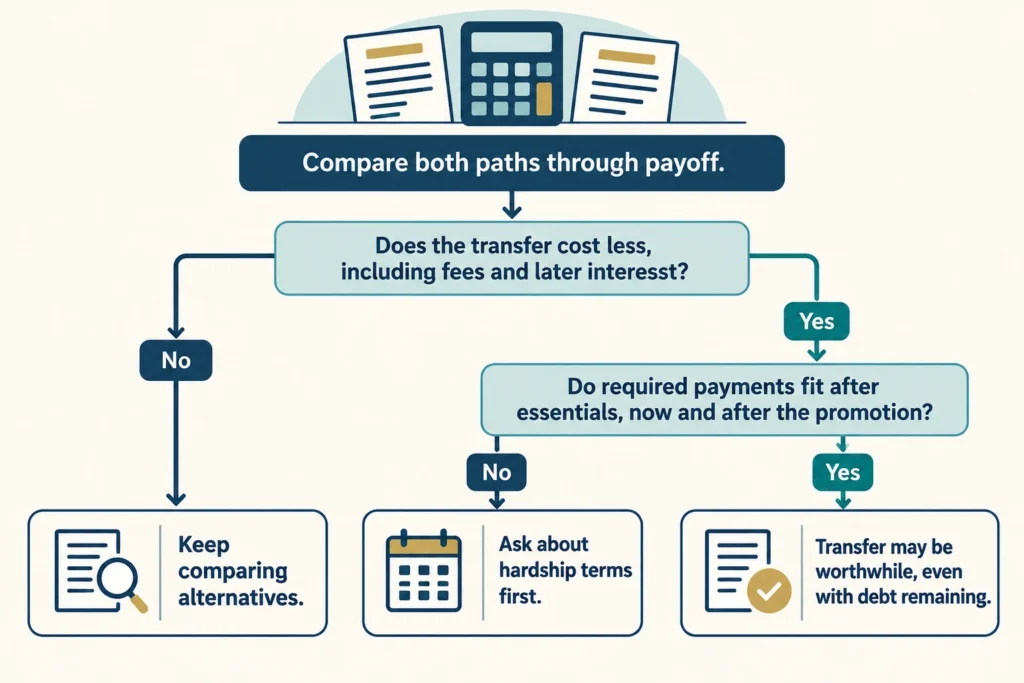
Even if you’ll still owe money when the promotional rate expires, a balance transfer can still be worth it. The comparison to make here is what each option costs through final payoff using the payment you can afford. Include transfer fees and interest that accrues after the promotional period. I’d take a cheaper option even if it doesn’t provide a perfectly timed, zero-balance payoff.
A lower APR balance doesn’t always mean a more manageable debt. If required payments prevent you from affording essentials like food, rent, and medicine, then a lower APR balance isn’t really helping you. Approval lets you know a lender is willing to extend you credit, but it doesn’t let you know if your household can afford to make the payments.
Imagine I’m at the kitchen table, penciling in an ambitious card payment, when the car-insurance renewal lands beside my calculator. I’m annoyed: the payment fits only if I pretend that bill doesn’t exist. I cross it out and use the smaller amount that leaves insurance funded. That’s the number the transfer has to work with.
A remaining balance doesn’t erase the savings
Let’s compare $6,000 of existing debt at 24% APR with a transfer charging a 5% fee, offering 0% for 21 monthly payments, then charging 28.49%. Your affordable payment is $200. These transfer terms come from the cited Wells Fargo Reflect disclosure, which also includes a matching purchase promotion and no annual fee. This is an illustration, not a card recommendation; your actual offer and assigned APR control.
The fee is $6,000 x 5% = $300, so the starting balance is $6,300. At 0%, clearing that in 21 payments means you would have to pay $300 a month. That is a payoff goal and is $100 beyond this household’s means.
| Measure | Keep the existing card | Transfer the balance |
|---|---|---|
| Starting balance, including transfer fee | $6,000 | $6,300 |
| APR | 24% throughout | 0% for 21 payments; then 28.49% |
| Balance after payment 21 | About $3,937 | $2,100 |
| Final payoff | Month 47 | Month 34 |
| Total interest plus transfer fee | About $3,255 | About $644 |
| Total repaid | About $9,255 | About $6,644 |
The transfer saves about $2,611, and is completed 13 months earlier, despite a higher APR later, and a balance of $2,100 remaining at transfer. During the promotion, a $200 payment fully reduces the balance, rather than partially paying down interest. The higher later APR is charged on a smaller balance. This is the third and best outcome I wanted to illustrate: a partial payoff of a promotion can still be beneficial.
These are editorial estimates using APR divided by 12, interest added before each end-of-month payment, and a constant later APR. Actual cards use daily-balance calculations; payment dates, processing interest on the old account, and variable-rate changes will alter the result. The example also assumes 21 usable payments, which an account-opening-based promotion may not give you after a delayed transfer.
The fee has to earn its place
In this example, the status quo results in $238 of interest after the first two payments, and $355 after the first three. Interest saved passes the $300 fee after the second two payments. If you could pay off the existing card within two months, then, according to these assumptions, it would be better to keep the card rather than make the transfer.
That early break-even check isn’t the whole comparison. A shorter promotion, larger fee, annual fee, or higher later APR can change the eventual savings. Compare both paths through payoff, and don’t build the plan around getting another promotional transfer later. That offer may not be available.
When the payment is too small, the answer changes
Let’s assume a more affordable payment of $100. With 21 promotional payments, the remaining balance is $4,200. At a 28.49% APR, it would take one more payment to generate $100 in interest and leave nothing for principal. Based on the cited agreement, the minimum payment would be 1% of the balance plus billed interest and fees, with a $25 minimum and rounding. The calculated payment would be $142.
A payment of $100 would not work. The same is true for keeping the current account. The existing $6,000 balance at 24% generates $120 in interest the first month. A transfer may give you more time, but if you can’t make a substantial payment to reduce the balance, you are postponing the problem.
In the end, you need to plan for the unforeseen. If your current payment plan means you can’t afford basic necessities, or the payment after the promotion is outside your budget, I would suggest contacting the creditor to negotiate a more affordable plan before opening another high-interest account. Understand the terms of the plan. Explain your financial situation. American Express has a hardship plan, but terms and availability are not guaranteed.
New purchases are a separate interest problem
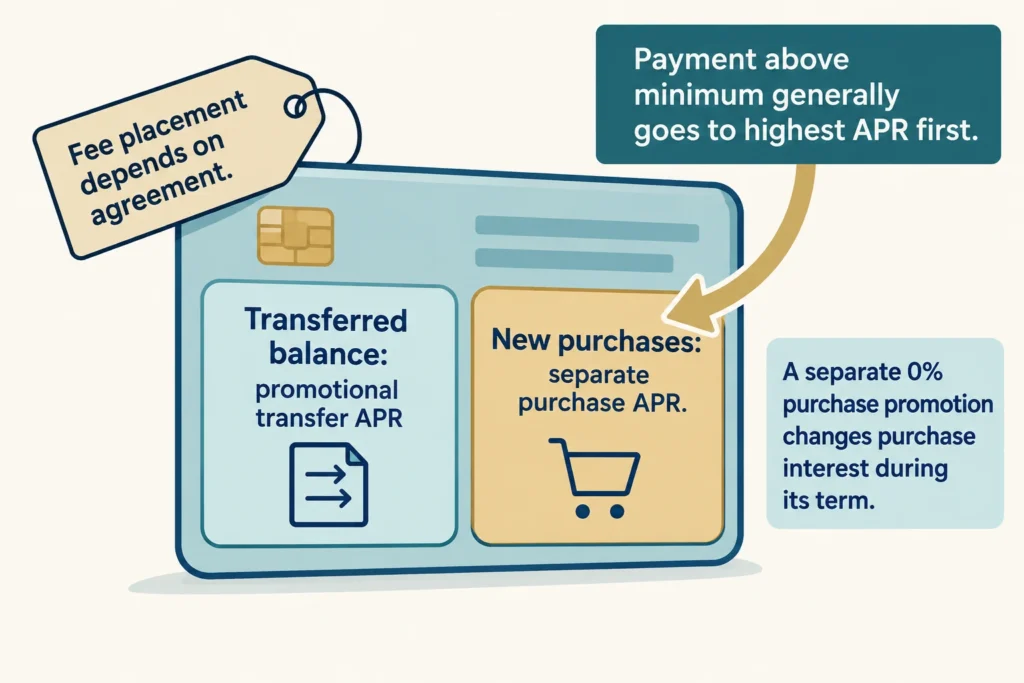
A 0% transfer rate doesn't mean 0% on purchases. Promotional balance transfers can remove the purchase grace period. New purchases will then accrue interest even if the promotional balance is paid off. A different 0% purchase promotion can prevent the interest. The cited Reflect offer has this promotion. Check your agreement for the conditions of the purchase grace period.
Fee placement also makes a difference. The cited agreement places transfer fees in the purchase balance. The example promotion simplifies the discussion, but different fee placement in a card's agreement can complicate the situation. With mixed rates, the general rule is that payments above the minimum go to the highest APR balance. The minimum payment itself is not allocated this way. Interest-bearing purchases can divert your payment from the transfer balance. I would avoid new purchases on this card and add a different card for new purchases.
Check what will actually move, and when
Available credit may have to accommodate both principal and fee. With $5,000 available and a 5% fee, the maximum principal is about $4,761.90: $5,000 ÷ 1.05. An issuer may impose a lower transfer cap or prohibit transfers between its own accounts. A partial transfer leaves two balances, two minimums, and potentially two due dates. Your affordable payment must cover both, not $200 on each because a spreadsheet quietly doubled your income.
Your 21-month clock starts when you open your account. You have to make qualifying transfer requests within 120 days. Processing takes around 2 weeks. Find these dates on your offer, and calculate the payoff payment using the formula: (fee-inclusive balance)/(number of payments you’ll actually have). A request deadline is not a reason to wait until the last day to make your request.
Keep making payments on your old account until the transfer is confirmed complete, check for remaining interest or untransferred debt, and then pay the new account on time. The CFPB says that being more than 60 days late is an exception to introductory rate protections; however, missing payments does not mean your rate will increase. The general rule of thumb is to always call to ask for a lower payment, if your payment does not fit. You should also know your expected credit limit (what your credit limit is likely to be when the promotion ends).
Sources and references
- Wells Fargo: Wells Fargo Reflect Visa Credit Card Terms and Conditions
- Wells Fargo: Wells Fargo Reflect Visa Credit Card Account Agreement
- Consumer Financial Protection Bureau: You could still end up paying interest on a zero percent interest credit card offer
- Consumer Financial Protection Bureau: Regulation Z, § 1026.53 Allocation of payments
- Citi: How Long Do Balance Transfers Take?
- American Express: I am struggling financially. Is there a program that can assist me with making payments on my account?
- Consumer Financial Protection Bureau: How long can I keep a low rate on a balance transfer or other introductory rate? (2024-09-23)