

If your provider’s terms work for you, coverage and affordability are key to direct issuer arrangements. If you’re not overwhelmed by the deadlines they set, then they’re a decent way to manage your debt. A debt management plan (DMP) is worth the cost if it gets a number of creditors to work with you on an arrangement you can manage. I’d pay for helpful debt management, not for a smaller-looking total balance.
However, if an arrangement leaves you without sufficient means to pay for basic necessities like food and housing, it's not a viable option. Making fewer calls would be nice, but it won't close a growing income gap.
First, untangle the similar names
DMPs generally work to repay your full principal, and can be a good alternative if your creditors are unmanageable. Credit card consolidation, debt settlement, and other alternatives work in different ways, and it's important to understand the nuances of a sales pitch before agreeing to anything.[2][3]
Negotiating with your credit card issuer for a repayment plan, instead of debt settlement, is the focus of these efforts. However, if someone suggests you stop paying your debts in the hopes of accumulating a bigger settlement offer, that's not traditional debt management. The unpaid debts will continue to accumulate interest, fees, and damage your credit.[1][3]
Get an offer for each account, not a general promise
Call the number on your statement and ask about hardship or repayment assistance, explaining what you can pay and when. Ask for the terms of the arrangement in writing, including the payment amount, APR, fees, start date, account restrictions, and how the issuer will report to the credit bureaus. The two most important dates for you are the expiration date of the hardship relief and the date when the outstanding balance would be repaid. Hardship relief may also include provisions for missed or partially missed payments. You need to know the provisions for hardship relief for a bad month in general, not just the first.[1][7]
Hardship relief offered by American Express is for periods of up to 12 months, and the terms and conditions of relief, as well as the reporting to the credit bureaus, are different for short-term and long-term relief. For temporary relief, I would not make the assumption that relief would last to the payoff date; I would ask what the payment and terms would be after the temporary relief.[7]
Picture me on an imagined lunch break, three statements beside a cooling sandwich. The second issuer’s hold music eats into my third call time, and I am already annoyed enough to want to have someone else make the third call. I would take the offers to a credit counselor, and ask which calls I would still need to make, and which bills I would still need to pay.
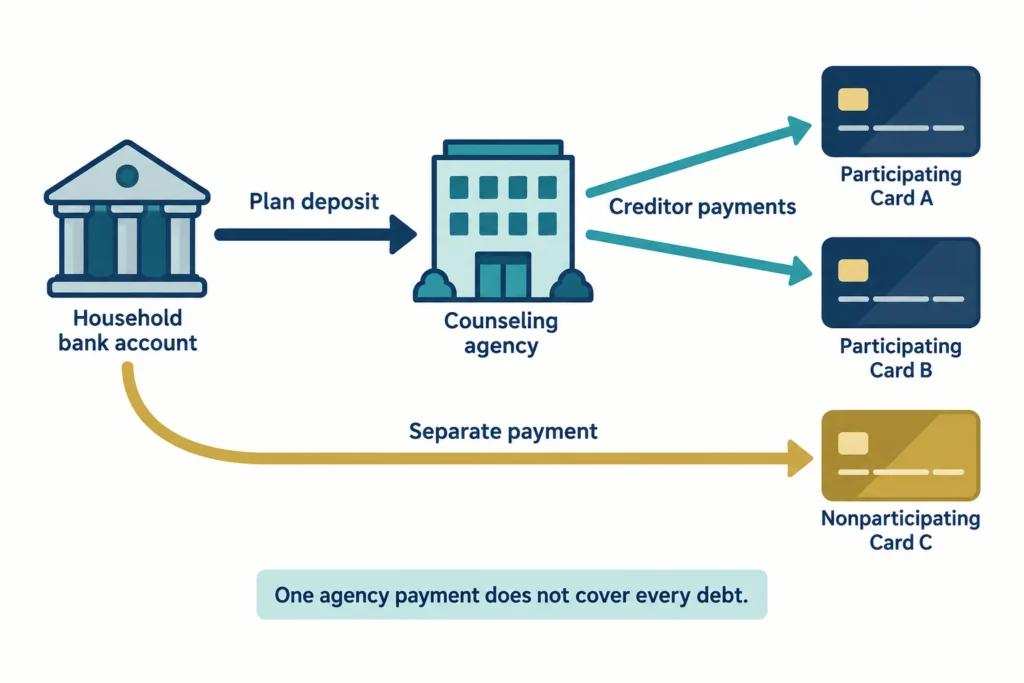
An ordinary debt management plan (DMP) covers unsecured debts, such as credit card debts, but usually does not cover mortgages and auto loans. Other unsecured debts require creditor acceptance on an individual basis. A counselor’s proposal does not mean every creditor has agreed to it. Ask for an account-by-account list, confirm participation, and get it in writing from the creditor.[1][2]
What the lower rate actually costs
Here’s a hypothetical comparison, not an available offer. You owe $6,000, $4,000, and $2,000 across three cards. Assume all three issuers offer direct repayment at 10% APR for 60 months, without added fees. The DMP instead offers 8% on every card for the same 60 months, plus a $35 setup fee and $30 monthly agency fee. All creditors participate, with no new purchases or missed payments.
| Cost | Direct arrangements | Debt-management plan |
|---|---|---|
| Monthly creditor payments | $254.96 | $243.32 |
| Monthly agency fee | $0 | $30 |
| Total monthly payment | $254.96 | $273.32 |
| Setup fee | $0 | $35 |
| Total paid through payoff | $15,298 | $16,434 |
In this case, the DMP rate results in about $11.65 lower monthly payments to the creditors, but the agency fee almost completely cancels that saving. You end up paying about $1,136 more for the service. While I might find the service worthwhile if it consolidates multiple accounts for me, I’d definitely want to know how much it costs up front. Actual DMP rates or waivers of agency fees could easily reverse the results of this example.
These are original calculations using monthly interest and level payments: monthly payment = balance × monthly rate ÷ [1, (1 + monthly rate)⁻⁶⁰], where monthly rate = APR ÷ 12 and APR is expressed as a decimal. Totals use unrounded payments. Actual card accounting and temporary concessions can change the result. For your comparison, use the agency’s written setup and monthly fees and ask about reductions or waivers; provider averages aren’t your quote.[2][4][5]
The card left outside still needs paying
Change one assumption: the $2,000 card won’t participate and stays at 24%. The other $10,000 remains in the DMP at 8%. Keeping the same 60-month repayment comparison and $30 agency fee, the combined monthly obligation becomes about $290.30. If you have $280 available for these debts, the original $273.32 plan fits, narrowly; this version doesn’t. Replace the illustrative outside-card payment with its actual required payment when checking your budget.
Nor can you assume you’re free to mix and match. Money Management International generally expects unsecured debts to be included, though it describes occasional exceptions. GreenPath says removing an account and paying directly typically doesn’t preserve its negotiated terms. Get permission and replacement terms before dropping an account.[4][5]
One payment means less work, not no work
The commitment includes more than payments. DMP repayment commonly takes several years; GreenPath describes three to five years and closure of included cards. Direct hardship arrangements can restrict purchases too. Ask what each offer means for new credit, any permitted card exceptions, and credit reporting. Neither route guarantees a better credit score.[1][5][7]
Here's what I'd research before moving payments: When exactly will each creditor receive payment? Your bank withdrawal, the collection agency's distribution, and creditor receipt do not happen at the same time. MMI recommends creditor due dates seven to ten days after its plan deposit date to allow processing, that’s its guidance, not a universal guarantee. Verify who pays each creditor during the transition, and when the first agency payment is distributed. Then, compare the agency's distribution record to the creditor statements. A bank withdrawal is not proof that a card has been paid.[2][6]
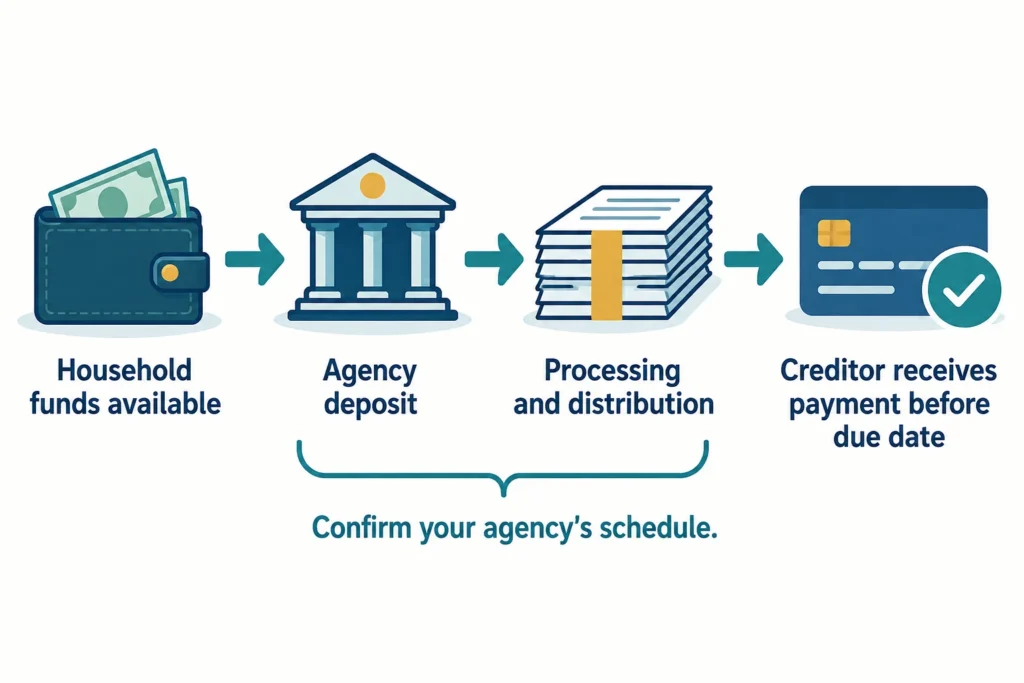
If a payment is going to fail, contact the agency or the card issuer before the payment is due and find out what can be changed. With a DMP, one short deposit can affect several accounts and creditors may withdraw concessions. Ask how a partially deposited payment is divided and what affects a returned debit. Find out if there is time to catch up. The consequences of a partially-deposited payment vary from program to program, and there is no universal missed payment limitation you can count on.[6][7]
Investigate the counselor, and the payment
I wouldn't trust the nonprofit status of a program as an indicator of quality. Research the program where your state requires licensing, check independent counselor certification, and research complaints against the program with your state Attorney General or Consumer Protection office. Find out how the counselors are paid and if their compensation is affected by enrolling people in the DMP. Approval to provide pre-bankruptcy counseling is not an endorsement of the DMP.[1][2]
You can obtain free counseling outside the debt management plan. You can ask for a household budget review, alternatives, written fees, and the proposed agreement, prior to making any commitment. If the recommendation is made prior to anyone doing a financial assessment, I would be skeptical. They haven't performed the work to do the financial assessment to determine whether the payment is appropriate.[1][2]
You could attempt a complete payment against a lower income month, after essential expenses, other required bills, and a share of predictable irregular expenses. Then put withdrawals next to your paydays. Moving a payment due date may help solve a timing problem, but will not resolve a recurring shortfall.[1][3]
If repayment means charging groceries again, don’t commit on that basis. Request further hardship relief and alternatives. If a full repayment is still unrealistic, a bankruptcy attorney can explain other legal remedies and help you determine the appropriate legal option. The available offers alone can't determine your legal option. Another repayment promise isn’t an answer to money that isn’t there.[1][3]
Bring your direct offers to the counseling appointment and ask: “Which creditors have accepted, what will I pay altogether, and what changes if I’m short one month?” That’s how you find out whether the fee buys help you can use, or another obligation you can’t carry.
Sources and references
- Federal Trade Commission: How To Get Out of Debt
- Consumer Financial Protection Bureau: What is credit counseling? (2023-08-02)
- Consumer Financial Protection Bureau: What is the difference between credit counseling and debt settlement, debt consolidation, or credit repair?
- Money Management International: Debt Management Plan FAQs
- GreenPath Financial Wellness: Frequently asked questions
- Money Management International: How to Get a Debt Management Plan
- American Express: Credit Bureau Reporting FAQs