

I’d recommend paying the highest APR card first if you’re looking to pay the least amount of interest. This is the default for me when you are able to cover all the minimums, keep the same total repayment budget, and avoid new charges. I also believe that paying the smallest balance first is also OK if removing a required payment allows you to sustain the plan, but I’d also want to know what that relief costs.[1]
The highest-rate approach is often called the debt avalanche; smallest-first is the debt snowball. Neither lets you skip another card’s minimum. Each account has its own obligation and due date, so a generous payment to Card A doesn’t satisfy Card B. Cover those separate minimums first, then concentrate the extra money on your chosen target.[1]
What the same $200 buys in each order
Let’s compare two hypothetical cards: $1,000 at 30% APR and $600 at 12% APR. Your total monthly payment is $200, not $200 extra, with a modeled $40 minimum on each card. That leaves $160 for the target and $40 for the other card. After one is cleared, all $200 goes to the remaining debt.
Here’s the arithmetic behind the estimates: multiply each balance by 1 + APR ÷ 12, then subtract its payment. Cap payments at the amount owed and send any leftover budget to the other card that same month. Rates stay fixed, with no purchases or fees. The supplied Chase agreement uses the larger of $40 or 1% of the balance plus billed interest and late fees, with additions for certain other obligations. In this example, the $40 floor controls until the payoff payment. Your card may use a different formula, and actual daily interest, payment dates, and rounding mean these are estimates, not payoff quotes.[2][3]
| Result | Highest APR first | Smallest balance first |
|---|---|---|
| First target | $1,000 card at 30% | $600 card at 12% |
| First card cleared | Month 7 | Month 4 |
| Required minimum total after first payoff | $40 instead of $80 | $40 instead of $80 |
| Planned monthly repayment | $200 | $200 |
| All debt cleared | Month 9 | Month 9 |
| Estimated total interest | $140.59 | $181.04 |
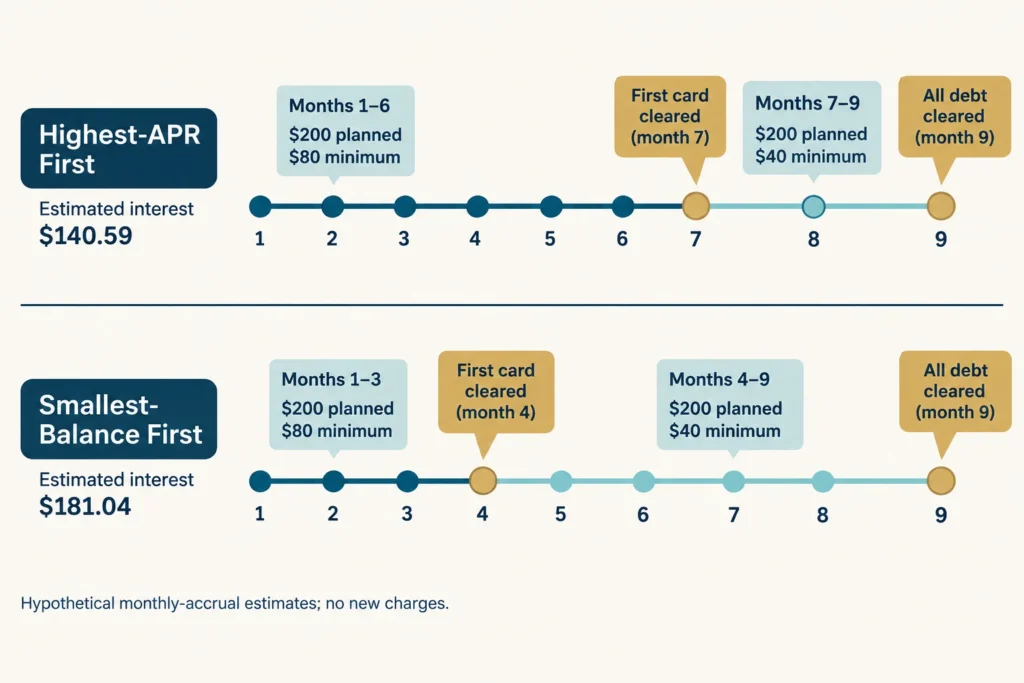
With highest first, you can make one required payment three months earlier, for a total of about $40 more in interest. I like that you can see the cost: you can decide if the value of the relief justifies the cost rather than being told that one way is morally right and the other way is wrong.
In this case, both methods end in month 9, but with highest first, you would have a smaller final payment.
With highest first, you would pay less because each dollar left on the 30% card would accrue more interest than a dollar left on the 12% card. If both APRs are equal, then this would not be the case under the same assumptions; you can payoff the lower balance card without having to pay an interest premium for the order.[1]
A disappearing minimum gives you a choice
Picture me looking at the $40 minimum with a tire replacement penciled in for next month. I’m annoyed because the spreadsheet has space for debt payments but not tire purchases. The spreadsheet assumes the tire replacement will be put off so the $40 can be given to the next card. The calendar gets a vote. I’d look at the price of slower payment and decide if the cash was worth avoiding a charge.
In the table, you roll the freed minimum forward. Required payments drop to $40 a month, but you’ve chosen to pay $200. You’ve gained the option to pay less in a bind, not free cash, while keeping the same path to payoff. With the option used, numbers change. You don’t need to close a paid off card to get rid of a required payment to eliminate a card’s balance.[1]
Suppose you take the smallest-first path, pay $200 through month 4, then keep $40 each month and pay $160 starting in month 5. The same calculation gives $196.98 in estimated interest and a month-11 finish, about $15.94 more interest than smallest-first with rollover. The extra 2 months and the lower expected interest come from changing the payment budget not from the order of repayment.
With smallest first, I’d keep the cash if it stops you from borrowing for an unavoidable expense. Leave a small cash buffer for the risk before considering it available for extra payment. Compare minimums on your statements to determine what releases what. The smallest balance doesn’t necessarily release the largest obligation.[3]
The progress you can see matters, but isn’t free
Small balances can seem satisfying to pay off, especially when you see noticeable progress after just one payment. The consulted Journal of Consumer Research abstract reports that concentrated repayment increased motivation, especially in smaller accounts where proportional progress was more visible. Just because people are motivated to pay smaller balances, does not mean smallest-first will get someone out of debt quicker.[4]
The table assumes you keep paying the same amount either way. If paying off a smaller balance with a premium helps you stick to your payment plan and adjusts your focus to the highest APR balances, then I see no harm in paying smaller balances first. Just because you pay smaller balances, does not mean you’re committed to smallest-first for life.
Promotional deadlines can change the target
Look for balances that say “no interest if paid in full” terms. Sometimes these offers mean the company defers the interest. The balance becomes due at the end of the promotional period and if it is not paid off, interest is charged retroactively from the date the purchase was made. It’s possible a minimum payment will not clear the balance, and the promotional period may be longer than your payment due date. If a balance has a promotional rate, it deserves a higher place in your payment priority than a regular balance.[6][7]
An ordinary introductory 0% APR term is different. The balance may become due at the end of the regular term, and interest is charged retroactively from the date of the purchase. Sometimes, a card’s regular APR may effect the card’s place in your repayment order.[6][7]
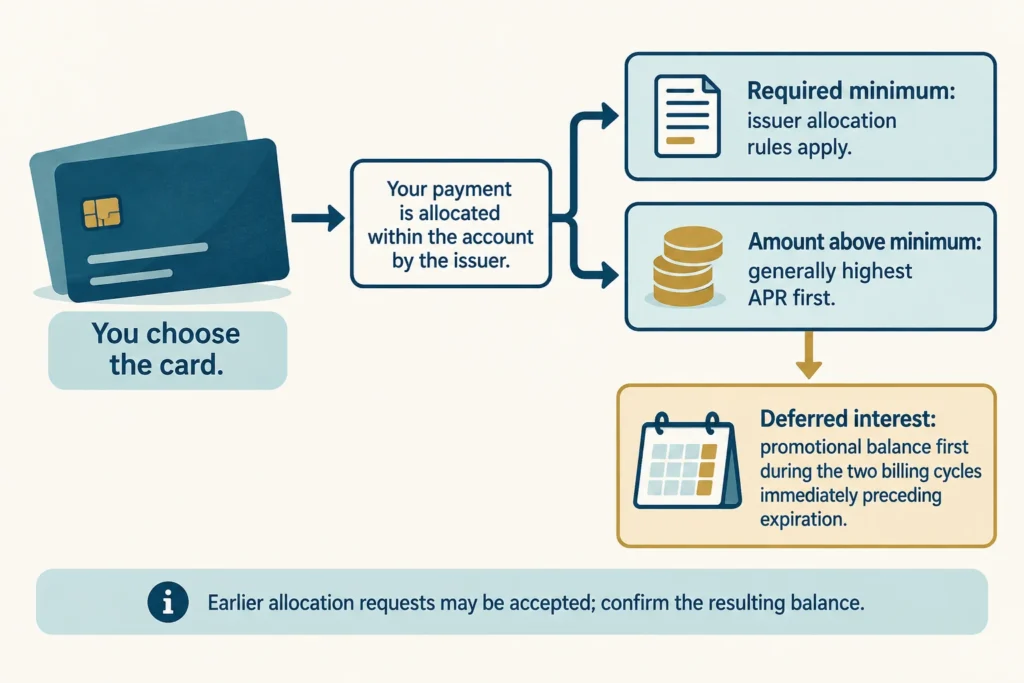
You select the account, but the issuer determines how to allocate payments among balances in that account. Regulation Z, in general, sends excess payments to the highest APR balance, but that rule does not apply to the minimum payment itself. So, directing a payment to a card with a promotion does not mean that the promotional balance is reduced by the same amount.[5]
Deferred interest balances have a special rule whereby in the two billing cycles immediately preceding the end of the deferred-interest period, excess payments must be first applied to the deferred-interest balances. Those are true billing cycles, not a 60-day window. The position of the end of the deferred-interest period relative to your payment due date is important. Earlier, an issuer may accept a request to apply excess payments to the promotion, but that is not required. You should contact the issuer to find out what payments will reach that balance before the exact end of the promotion, and then review your statement to see if the payment allocation occurred.[5][6]
An average of $300 allocation each payment gives you three payment opportunities to pay down a $900 deferred interest balance. You have a total monthly debt budget of $200. With minimum payments to make on other cards, you’re out of debt budget before covering minimum payments. Contact the issuer to allocate payment opportunities and determine available payment options, while also covering minimum payments. Unless a different allocation, additional money, or a negotiated change in terms closes the gap, the promotion will not be paid off; asking for an extension does not change the terms of the promotion. Arithmetic states that avalanche, nor snowball, will not solve the problem.[5][6]
Put each card’s balance, APR, minimum, and promotion expiration side by side when preparing for your next payment. Without a deadline exception, I would pay the promotion with the highest APR first. If a small payoff would meaningfully lessen your required payments, consider a small payoff and decide where to allocate the freed minimum payment before the small payoff.
Sources and references
- Consumer Financial Protection Bureau: How to reduce your debt (2019-07-16)
- JPMorgan Chase Bank: Chase cardmember agreement COL00040
- Chase: How to Calculate Your Minimum Credit Card Payment
- Journal of Consumer Research / Oxford University Press: Repayment Concentration and Consumer Motivation to Get Out of Debt (2016-08-09)
- Consumer Financial Protection Bureau: Regulation Z § 1026.53 and official interpretations
- Consumer Financial Protection Bureau: Deferred-interest credit-card purchase explanation
- Synchrony: Understanding Deferred Interest