
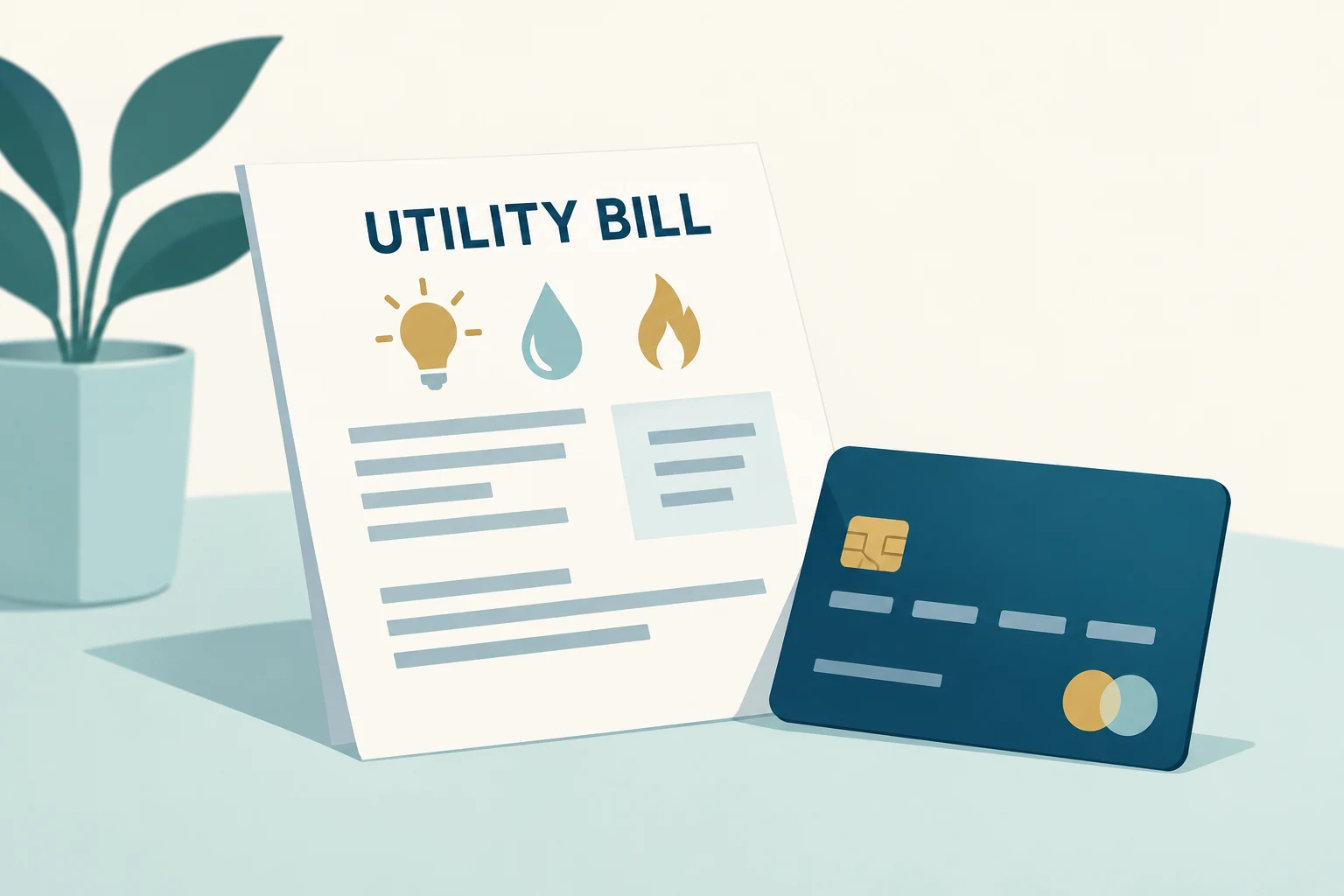
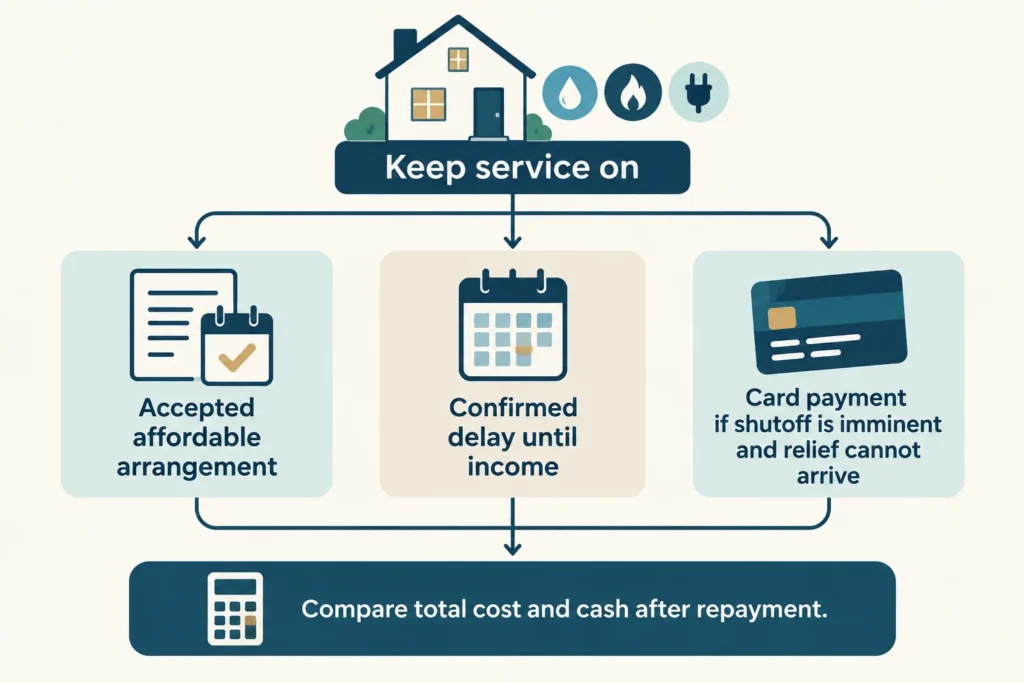
Don’t charge a utility bill to your credit card just because it’s late. See if the utility will allow you to set up a work out, or at the very least offer a short temporary forbearance until you receive your next income. If the utility will not allow either of those options and disconnection is imminent, then charging the utility to avoid disconnection is justified. Charging a utility to keep your account in good standing is never justified.[1][2][5]
The second, and equally important, question is: after you pay the credit card bill, will you have money to buy essentials until the next payday? Only charge the bill if you are certain you will be able to pay it off.
Find the service deadline, not just the bill's due date
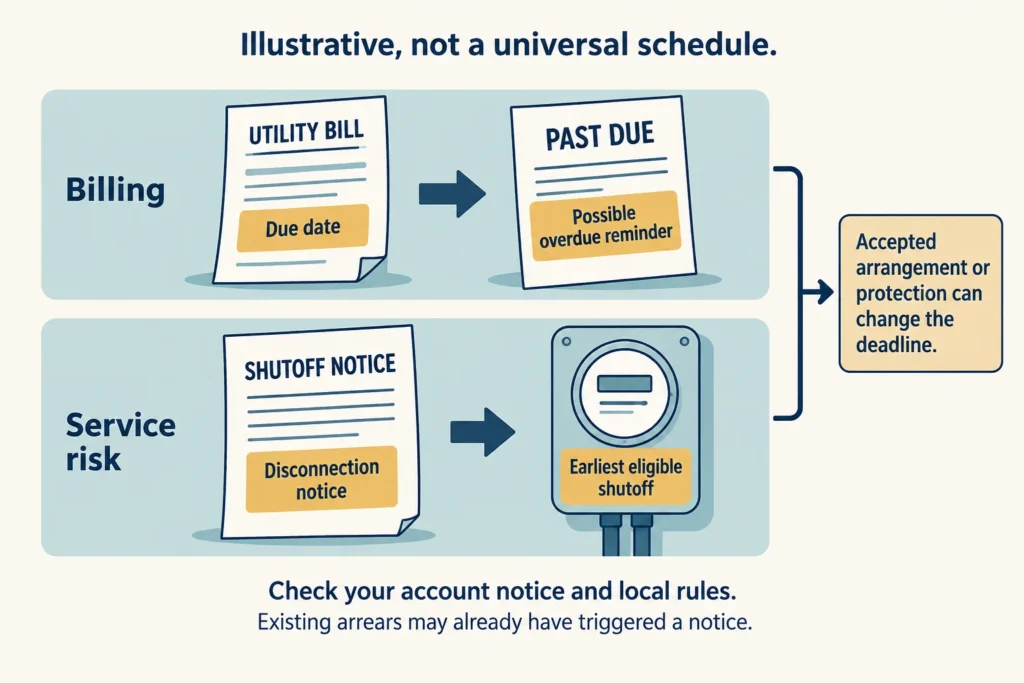
A due date for a payment, a reminder for a past due payment, and a disconnection notice are not the same thing. Just because you did not pay a past due bill, does not mean your service will be disconnected the next day. A past due bill does not mean you will automatically receive a disconnection notice. There is not a national “ standard” waiting period for a bill to be disconnected, and you shouldn’t assume there will be for your account.[1][8][9]
Imagine I'm at the kitchen counter with an overdue electric bill, a nearly empty checking account, and a paycheck arriving Friday. I start opening the card-payment screen, annoyed that even waiting two days seems to require borrowing. Then I stop: I haven't checked whether Friday is actually too late. I pull up the notice and call about the service deadline before turning a timing gap into debt.
The call is worth making because you need four account-specific facts: the earliest disconnection date, the exact amount that would prevent it, when that payment must arrive, and what arrangement or protection would create a hold. Use the number on your bill or the utility's official website, and ask whether your chosen payment method will arrive in time. I wouldn't assume you need the full balance, but I wouldn't send an arbitrary partial payment and hope it stops the shutoff, either.[1][4][5]
Where you live can change both the urgency and the cost of waiting. For covered residential customers, New Jersey's published rights require at least 10 days' written notice before nonpayment shutoff and prohibit residential late-payment charges. Its Winter Termination Program protects eligible customers from November 15 through March 15, but customers need to call to request protection. Those aren't national rules, and winter protection doesn't erase what you owe. If the utility's answer conflicts with a published protection, bring the notice and account details to your state utility regulator rather than treating the first answer as final.[1][2]
If losing service would threaten someone's health, tell the utility immediately and ask what medical certification would protect the account now. Ohio's covered residential energy rules, for example, provide a 30-calendar-day medical-certification protection with documentation and payment-plan requirements. Illness alone isn't an automatic hold everywhere, so you need confirmation of protection, not just a note that someone took your call.[8]
An arrangement may beat both waiting and borrowing
I’d prefer a plan to extend your repayment or accept smaller payments over a short-term loan if the due dates and amounts line up better with your pay periods. The problem is what happens next: the old bill doesn’t go away while you’re paying it off. New Jersey’s deferred payment protection program, for example, requires customers to keep up with new charges while they pay off old charges. You have to pay both before considering the program. A small payment isn’t much help if it puts you right back where you started.[1]
| Your situation | What I'd favor | What must be confirmed |
|---|---|---|
| An affordable arrangement has been accepted | Use the arrangement rather than borrowing unnecessarily. | The shutoff hold, installment dates, fees, and treatment of new bills. |
| Disconnection is imminent; no timely arrangement or assistance works | Consider charging the amount required to prevent shutoff. | Required amount, payment receipt deadline, card costs, and whether repayment creates another essential-bill shortage. |
| Reliable income arrives after the due date but before disconnection | A short delay may be better than a card payment. | Service remains on through that date, the payment can arrive in time, and any utility charges are acceptable. |
Help may mean you don’t need to borrow, but I wouldn’t count it as money received or as permission to delay before you get official confirmation from the agency. The agency has to verify your household and services qualify, that your forms are complete, if funds are available, and when help will reach your account. LIHEAP may help cover your home energy costs, which may include your water heater, but not your water bill. Separately, the utility will have to confirm that an application or agency pledge created a disconnection hold and when that hold expires.[3][4]
Not all expedited responses are posted credits. New Jersey's FY 2027 LIHEAP plan states that crisis intervention will occur within 48 hours for eligible crisis cases and within 18 hours for life-threatening crises. This doesn't mean payment will occur within these time frames. Ask the agency when their response time starts and whether they contacted the utility. The status that changes your mind is "shut off suspended" not "application submitted."[4]
Price the card payment you're actually making
Assessing the utility's confirmed charges and arrangement fees versus the processor's fee and interest is beyond the scope of this post. Card options may not always be free. PSEG Long Island in New York says there's no credit/debit processing fee for residential customers, but your utility may charge for checkout. The fee shown for your payment is the one to use, not a hypothetical example.[1][5]
Interest depends on how the payment is classified and whether your card still has a purchase grace period. With an active grace period, meeting its full-payment conditions can avoid purchase interest. If you've lost it by carrying a balance, a new purchase may start accruing interest without waiting for the next due date. That's the detail I'd check before calling this a short, interest-free bridge: paying back just the utility charge may not satisfy the conditions.[6][7]
Your own agreement supplies the purchase APR and the amount you must pay to avoid purchase interest. If the transaction's classification is unclear, ask the issuer about the specific payment service before authorizing it. Withdrawing cash to pay the utility is a different proposition: cash advances generally accrue interest immediately and can carry separate fees.[6][7][10]
A modest interest charge can still leave you short
Here's a hypothetical calculation: a $240 utility bill plus an assumed $3 processing fee puts $243 on the card. With no purchase grace period, a 24% APR, and repayment after 30 days, approximate interest is $243 × 0.24 × 30 ÷ 365 = $4.79. Estimated repayment: $247.79. This simplified estimate assumes no other balance, intervening payments, or new purchases and excludes compounding, rounding, and minimum finance charges; your actual statement can differ.[7][10]
Using the same example, assume you need $900 to meet your other financial obligations, and your payday is the next available day. Your available cash is $1,150. Borrowing $247.79 reduces your cash by $2.21 and meets your financial obligations. Adding the $7.79 interest significantly reduces your cash and isn't "comfortably" affordable.
Work out what cash you'll have available after payday and the following essential and utility expenditures, less the total card payment you are planning to make, including existing debt. That cash payment should cover the full payment, at least the minimum required payment, to avoid extra charges. A purchase may be covered by a grace period, but, to avoid interest, the full payment must be made during that grace period. In the absence of other means, making a payment that covers the minimum may free up cash, but interest will continue to accrue on the unpaid balance. A cash payment, for emergency purposes, to cover a bill that would otherwise result in a shutoff, may be prudent. However, that payment, if it also covers the minimum payment, will do nothing to repay the borrowing and may result in the continuation of the accumulation of interest on that unpaid balance.[6][7][10]
A receipt may not stop a scheduled shutoff
After making a payment, I don't close the screen and assume the service issue is resolved. PSEG Long Island requests a follow-up call to confirm payment for a shutoff. Keep your payment receipt or the terms of the accepted arrangement and contact the utility: "is the disconnection halted, and what is the next payment due by?" just paying a lower balance doesn't guarantee the disconnection will be halted.[5]
If service has already been shut off, the focus is on what will restore it. Will it take a payment and/or a reconnection fee or deposit, and what methods of payment will be accepted? What is the approximate time it will take to restore service? These may differ from what would have prevented a shutoff. New Jersey provides for qualified assistance-application reconnection, allowing for a 25% down payment on the outstanding balance, once per year per utility service. Get the approximate time it will take to restore service before deciding what to charge.[2]
Sources and references
- New Jersey Board of Public Utilities: New Jersey Utility Customer Bill of Rights (2023-03-16)
- New Jersey Board of Public Utilities: New Jersey Utility Assistance Programs
- New Jersey Department of Community Affairs: FFY 2027 LIHEAP and USF Fact Sheet
- New Jersey Department of Community Affairs: New Jersey FY 2027 LIHEAP Detailed Model Plan (2026-08-14)
- PSEG Long Island: PSEG Long Island Credit and Debit Card Payment Terms
- Consumer Financial Protection Bureau: What Is a Grace Period for a Credit Card? (2024-09-23)
- JPMorgan Chase Bank: Chase Cardmember Agreement COL00079
- State of Ohio: Ohio Administrative Code Chapter 4901:1-18
- Public Service Electric and Gas Company: PSE&G Scams and Fraud
- Consumer Financial Protection Bureau: How Does My Credit Card Company Calculate Interest? (2024-01-22)