

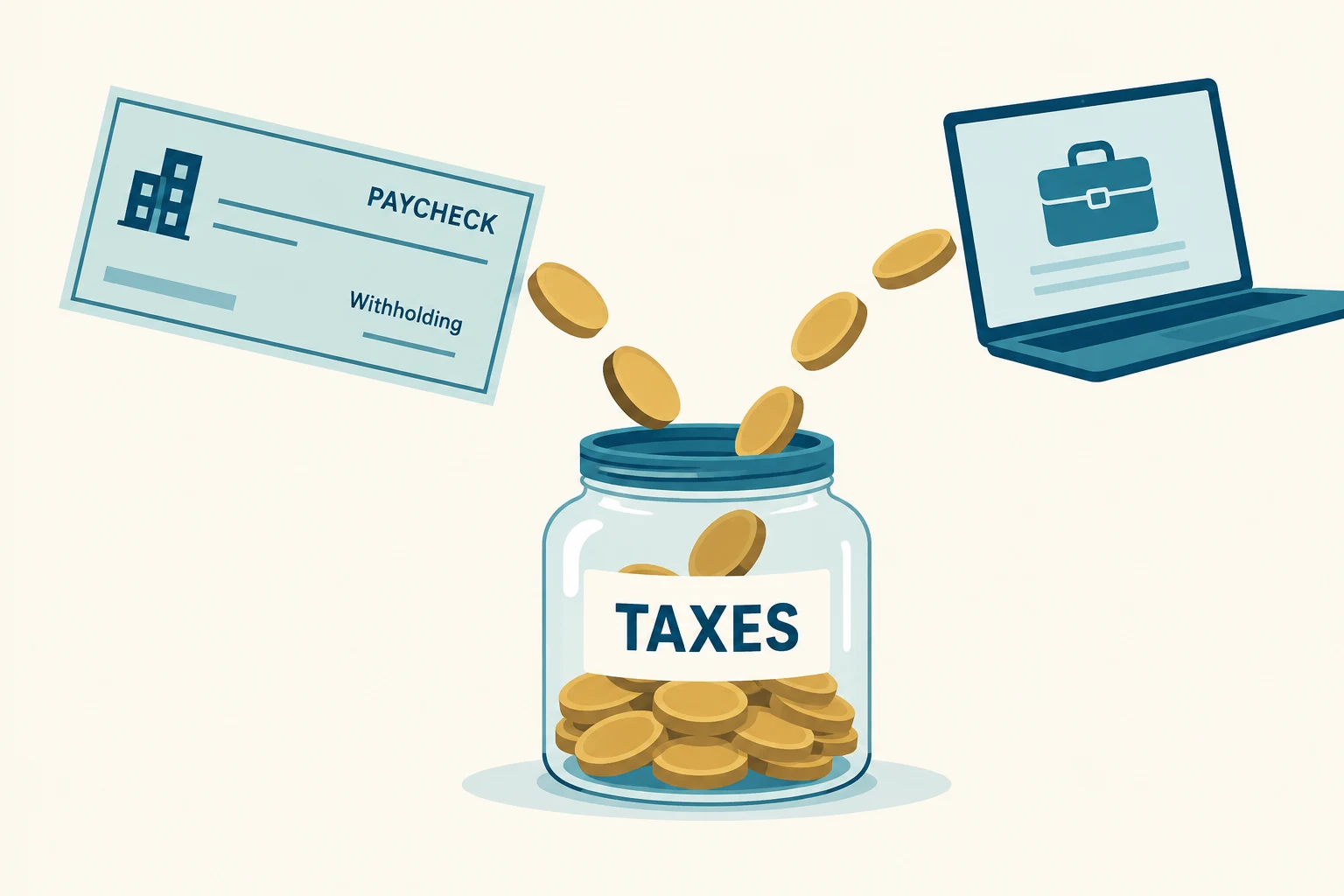
Set aside part of your projected household tax that your paycheck withholding and tax payments don’t cover, not necessarily an automatic 30% of every gig deposit. Subtract the cash you’ve already set aside to see how much more you need to set aside. I’d rather start with that dollar gap. A blanket percentage can leave you short, or tie up money you need for the grocery run.[3][5][7]
Picture me looking at a freelance deposit with a utility bill next to my laptop. I’m relieved, then annoyed. The balance tells me what came in, not what I can spend. Instead of guessing and moving a percentage, I look at my withholding and expenses. That’s what keeps “found” money from being borrowed money.
Start with profit, not the deposit
I’d start looking for the deposit where you’d start looking, but it may not necessarily be your taxable profit. Gross receipts are what your customer paid before any deductions. A platform may remove its fees before sending you the money. Your net business profit is gross receipts less deductible business expenses. Reconcile the difference between what the platform and you paid or incurred, rather than assuming either the deposit or a Form 1099-K amount is profit, and don’t deduct a fee twice because it appears in both.[1]
That profit generally brings two federal taxes. Income tax depends on your whole return. Self-employment tax pays toward Social Security and Medicare, even though your regular job already withholds those taxes from wages. In the ordinary calculation below the Social Security wage limit, it’s 15.3% of 92.35% of profit, or about 14.13% of profit. It generally applies when net self-employment earnings reach $400; that threshold isn’t an income-tax exemption.[2][7]
There’s an offset, but not a refund of half the tax: you can generally deduct half of self-employment tax when figuring income subject to income tax. An eligible qualified business income deduction, or QBI deduction, can reduce income tax further, though it doesn’t reduce self-employment tax. I wouldn’t simply add your tax bracket to 15.3% and call the result your reserve. That skips deductions and, more importantly, what your paycheck is already paying.[2][6]
Turn the household estimate into a cash target
To estimate your income taxes, you will need your recent paystubs, last tax return, expected gig economy receipts, expected gig economy expenses, and your expected federal income tax withholding, which you’ll likely need to estimate. The withholding you are currently having done likely isn’t a good indicator of the total withholding you’ll have done by the end of the year. Your spouse’s income and withholding should also be factored into your estimate. In general, you should use the IRS’s withholding estimator to help you rather than assuming the tax withholding for your household is zero.[5]
Here’s an example of what a household could look like in 2026. You’re single, and under 65, with $80,000 in wages subject to federal income tax, before any deductions, $12,000 in gig receipts, and $2,000 in business expenses, which are deductible. You take the $16,100 standard deduction, and qualify for the full ordinary 20% QBI deduction, with no limits. Assume no other income, adjustments, deductions, or credits. Also assume no other taxes, except state and local taxes. Your projected federal payroll withholding is $9,370, and you’ve made no estimated payments.[3][6][7]
| Calculation | Approximate amount |
|---|---|
| Gig profit: $12,000 receipts, $2,000 expenses | $10,000 |
| Self-employment tax: $10,000 × 92.35% × 15.3% | $1,413 |
| Deductible half of self-employment tax | $706 |
| QBI deduction: ($10,000, deductible half of self-employment tax) × 20% | $1,859 |
| Taxable income: wages + profit, half of self-employment tax, standard deduction, QBI deduction | $71,335 |
| Income tax using 2026 single-filer brackets | $10,406 |
| Total federal tax: income tax + self-employment tax | $11,819 |
| Subtract projected federal paycheck withholding | , $9,370 |
| Federal tax still needing funding | $2,449 |
To reproduce the income tax, add $1,240 on the first $12,400, $4,560 on the next $38,000, and about $4,606 on the remainder. The uncovered $2,449 is about 24.5% of gig profit, or 20.4% of gross receipts. Same bill, different denominator. Neither percentage is a recommendation for you: this household’s existing withholding already covers some of the added tax.[3]
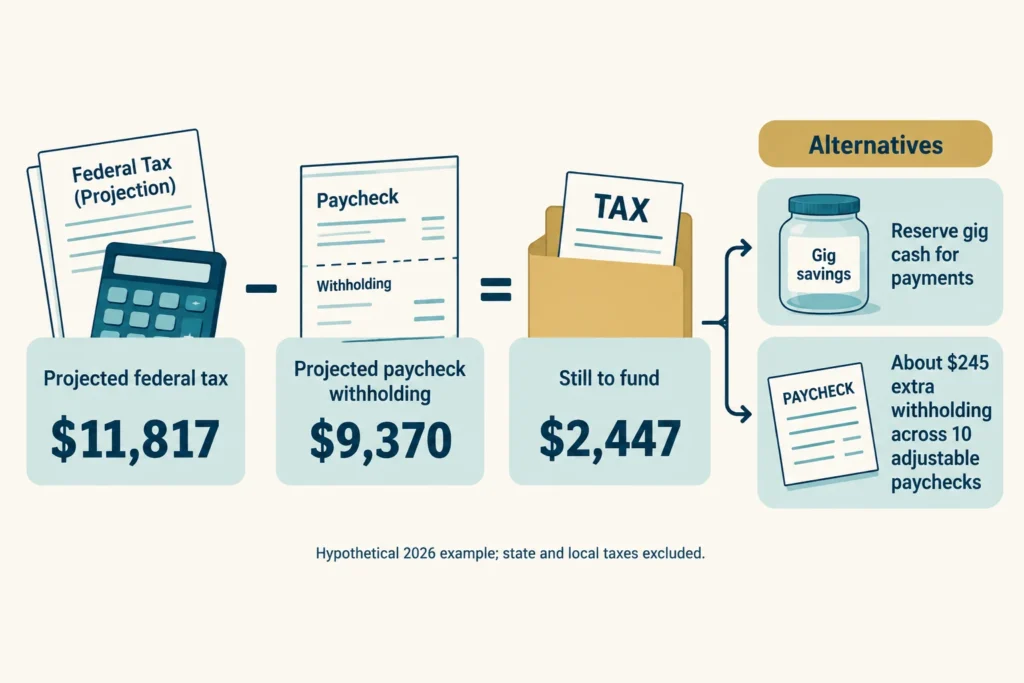
If you’ve set aside $800 for taxes, you would need to set aside about $1,649 more. That cash is waiting to pay the IRS. I prefer keeping three things separate; the money owed, money being paid, and cash waiting to be paid. If you expect extra withholding from your regular job to cover the shortfall, you don’t need to set aside the same cash from your gig income. Your regular take home pay will be less.
A smaller paycheck or estimated payments?
I would go with the extra paycheck withholding option if your normal paychecks can cover the cut. With this option, you don't need to worry about another payment schedule. The W-4 asks for an additional dollar amount with each paycheck in Step 4(c). If you have 10 paychecks to adjust, the example amount of $2,449 would require an additional $245 per check. The start date of payroll is important because a check that's already processed can't change the future pay periods.[4]
For self-employment income, the W-4 instructions say to use the withholding calculator and not to enter that income in Step 4(a). Use the recommendation made by the calculator and do not make this adjustment as well. You can change this at the beginning of the year. A catch-up amount needed to be withheld in a few pay periods during the year can cause too much to be withheld over the year.[4][5]
If you don't have enough ordinary paychecks to cover normal bills, estimated payments may work better. You hold on to the self-employment tax cash and make the payment yourself. The regular due dates for 2026 are April 15, June 15, September 15, and January 15, 2027. Not every quarter is the same. Keep payment money and spendable money separate. Check if there are exceptions or relief for a particular event that may change your payment dates.[3]
Penalty protection is not a paid-in-full promise
There are two different questions here: how much you need to pay during the year to avoid an underpayment penalty, and how much you’ll ultimately owe. Generally, estimated payments are required when you expect to owe at least $1,000 after withholding and refundable credits, and those amounts won’t cover the smaller of 90% of current-year tax or 100% of prior-year tax. The prior-year target becomes 110% if your 2025 adjusted gross income exceeded $150,000, or $75,000 if married filing separately. That prior-year return must cover 12 months, and payment timing matters.[3][7]
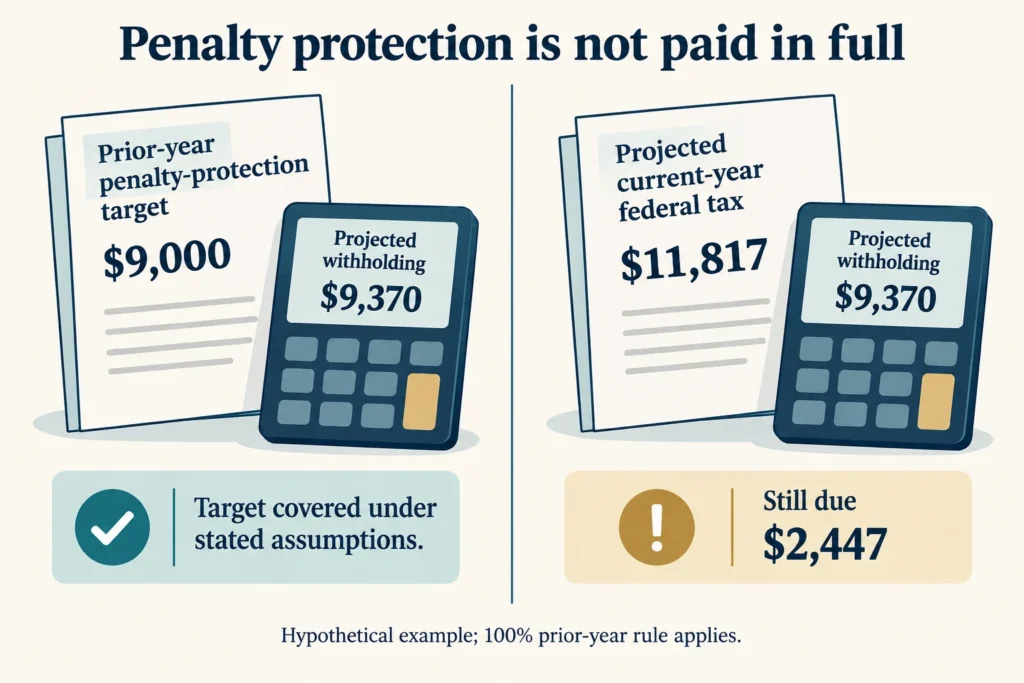
Let’s say your prior year’s tax liability was $9,000 and the 100% rule applies. In this scenario, withholding of $9,370 for the current year would protect you from the underpayment penalty. However, that would still leave you with a tax liability of $2,449 for the year. That’s what I don’t want concealed behind “safe harbor”. Safe harbor protects you from the underpayment penalty, but it does not protect you from having to pay the tax liability.[3][7]
If you are trying to catch up for the year, withholding has a timing benefit. Federal withholding is generally treated as paid one-fourth at each installment deadline, unless actual-date treatment is used. Estimated payments retain their actual payment dates, so sending a payment late generally does not wipe away an earlier underpayment. Extra withholding can help, but only if payroll actually withholds enough before the end of the year. A completed W-4 form for the next year, however, will not help you.[7][8]
Update when earnings change, and check beyond federal tax
A major change in income, like a big gig payment, a new job, or a large expense, means it’s time to reestimate. For the year as a whole: applying a new percentage only to future deposits won’t account for the tax cash flow for earlier income you already spent. Earning income late is different from paying it late. Using the annualized income installment method may reduce required payments for earlier years, but it requires specific records for each period and Form 2210, not a lower payment estimate.[7]
The federal calculation can’t be substituted for state and local taxes. In California, the typical estimated payment allocation is 30%, 40%, 0%, and 30%, so using the federal payment allocation would be wrong in that state. Philadelphia has separate Business Income and Receipts Tax and Net Profits Tax obligations for independent contractors. These are not nationwide rules. They show why there is a need to come up with separate tax and payment estimates for each jurisdiction.[9][10]
You may want a fuller projection from a CPA or enrolled agent, if you have income-dependent credits or Marketplace insurance subsidies, work across states, have questionable deductions, or have missed payments. Ask them to approximate your remaining balance and the payments needed on the due dates; a tax bracket shortcut can’t do that. High income changes the self-employment calculation for 2026. You and your spouse wouldn’t share a Social Security wage base of $184,500 for self-employment income taxes. For Medicare taxes, you would.[7]
Prior to spending the next gig deposit, subtract your tax cash on hand from your funding gaps for the IRS, the state, and your locale. Then decide which of those gaps will be covered by a gig payment and which will be covered by smaller paychecks. Once that’s determined, enter the payment amount and due date next to it. Money in the bank is helpful, but it’s no good if it’s not in the hands of the tax agency when it’s supposed to be.
Sources and references
- Internal Revenue Service: What to do with Form 1099-K
- Internal Revenue Service: Instructions for Schedule SE (Form 1040) (2025)
- Internal Revenue Service: 2026 Form 1040-ES (2026-02-12)
- Internal Revenue Service: 2026 Form W-4 and instructions
- Internal Revenue Service: Tax Withholding Estimator
- Internal Revenue Service: Qualified business income deduction
- Internal Revenue Service: Publication 505 (2026), Tax Withholding and Estimated Tax
- Internal Revenue Service: Instructions for Form 2210 (2025)
- California Franchise Tax Board: 2026 Instructions for Form 540-ES
- City of Philadelphia Department of Revenue: Five things to know as an independent contractor working in Philadelphia (2025-10-29)