


No. Turning off the federal opt-in for overdrafts only stops fees for ATM and one-time debit card overdrafts once the change takes effect. There is no protection for checks, ACH payments, and recurring debit card purchases. “Overdraft protection” may be a separate savings transfer or credit service.[1][2][6][8]
I'd suggest that opting-out is a temporary solution to protect against one-time purchases or to prevent a bank account from going too far into the negative. The name of the setting does not matter. The type of payment being protected does.[1]
Start with how the money leaves your account
| Payment | Must you opt in before the bank can charge for paying the overdraft? |
|---|---|
| ATM cash withdrawal | Yes, under the covered overdraft service. |
| One-time debit-card purchase, such as groceries | Yes, under the covered overdraft service. |
| Recurring debit-card charge, such as a monthly subscription | No, not under this particular rule. |
| Check or ACH debit using your routing and account numbers | No, even if the ACH payment happens only once. |
There are some exceptions to what protection “one-time” purchases have. For example, what may be considered a one-time purchase by the bank, may not be considered one-time by you, the consumer. You should ask the bank how it classified a charge instead of assuming based on a statement description.[1][3]
Opting out also doesn’t guarantee a decline. An ATM or everyday debit transaction can still overdraw the account, for example, when a card purchase settles later, but without opt-in, the bank cannot charge for paying that covered overdraft. You still owe the negative balance. Conversely, opting in doesn’t require the bank to approve a transaction.[1]
A declined bill isn’t a resolved bill
Imagine I’m looking at $40 available and a $100 phone ACH debit due tomorrow, with no linked funds. I’ve switched off everyday debit overdrafts, and notice the phone bill is using my account number, not my card. So much for having that settled. Instead of trusting the switch, I’d ask the phone company if I could change the payment date, and if that would also stop the ACH debit.
If the bank pays that $100 debit, the account balance becomes negative $60 before any fees are charged. If the bank does not pay the debit, you still owe the phone bill, and the phone bill may charge a returned payment fee. Consequences also depend on any laws or contracts. None of the fees or consequences are certain.[2][4][5]
I read both the fee schedule and the contract to get the whole story. Navy Federal’s disclosures include the possible charging of NSF fees, but its current fee schedule does not charge for items returned unpaid. Chase also says it does not charge for returned checks or ACH payments. The fact that your account permits a fee to be charged is not the same as your account currently charging the fee.[4][5][7]
Linked money is a different arrangement
Linked savings use your own money to cover a shortage. Credit based protection borrows money. Neither is the same as consenting to everyday debit overdraft fees. So I wouldn’t turn off a linked service just because it has the word “overdraft” in it. First find out which payments it can cover, what it costs, and which source of money it uses first.[1][6][7][8]
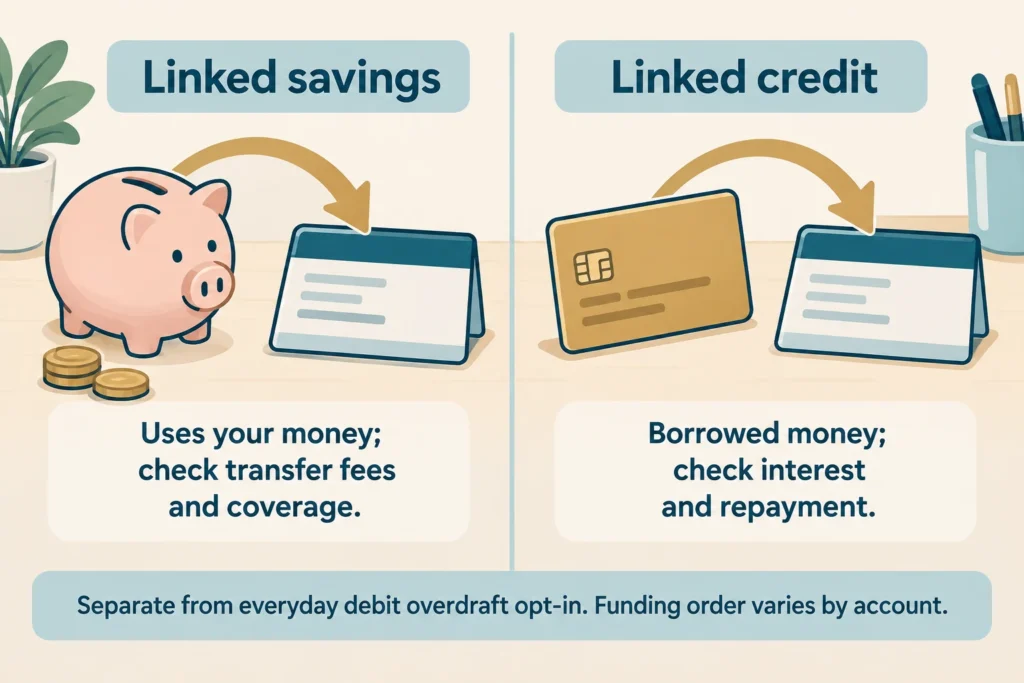
The differences aren't just in the names. Currently Chase doesn't charge for transferring money from a linked savings to help fund a transaction. Navy Federal doesn't fund a point of sale authorization with their savings transfer service and their disclosures show that if both savings and credit are linked, the credit is prioritized, meaning that if you're trying to avoid going into debt, savings may not always protect you from the credit risk.[6][7][8]
Before changing your settings, check these four things
- Ask which setting you're changing: ATM/everyday debit, discretionary ACH, linked savings, or linked credit. Confirm what stays active, are there any transfer fees or interest, and which backup funds get used first.
- What is your next bill? Is it an ACH debit, a card charge, or a check? Ask what happens if the account has a low balance? Would funding be prioritized to avoid a return or overdraft?
- What recent fee did you incur? Ask what the underlying transaction was? Is it check processing? What is your current fee schedule? What is your fee threshold? Are there any deadlines to avoid a fee?
- Learn the exact moment when your opt-out request goes into effect. Because there’s a lag between the time a request to opt-out is made and the time that request is processed, it’s possible you could still be charged after you make the request. You’re still responsible for the fees even if you opt-out.
Sources and references
- Consumer Financial Protection Bureau: Regulation E § 1005.17 and official interpretations
- Consumer Financial Protection Bureau: What can I do if my bank charged me a fee for overdrawing my account? (2025-01-02)
- JPMorgan Chase Bank: Chase Deposit Account Agreement
- JPMorgan Chase Bank: Standard Overdraft Practice
- Navy Federal Credit Union: Fees & Charges
- JPMorgan Chase Bank: Overdraft Protection
- Navy Federal Credit Union: Navy Federal Credit Union Important Disclosures
- Navy Federal Credit Union: Checking Protection Options