

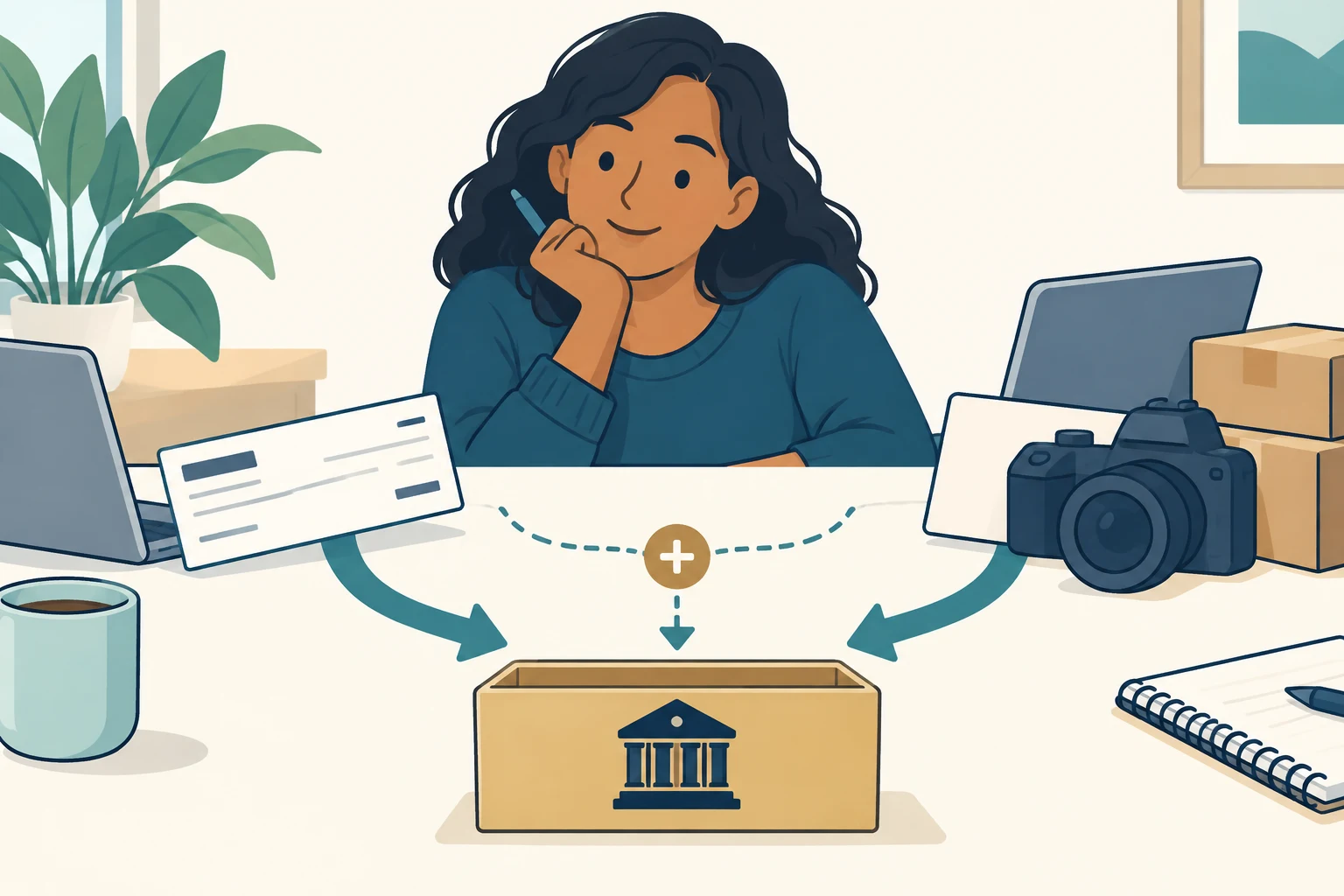
Increasing withholding is often enough to cover taxes on side hustle income and avoid having to make estimated tax payments. I’d favor withholding if the remaining paychecks can comfortably cover the gap, estimated payments if funding taxes directly from gig earnings feels better, and a combination if neither option works well alone. First, estimate the same household tax bill for all three options.[4][6]
Imagine I’m reviewing a new payroll deduction while the rent autopay is scheduled for Friday. The tax plan looks automatically beautiful; the checking account balance looks less impressed. I’d stop and ask if the gig account could fund part of the tax before I submitted it. Less administration is good, but not if it creates a shortfall for necessities.
The rules and dates below are for 2026, assuming the federal rules remain the same. State obligations require a separate calculation.[1][2][7]
Start with profit, not the deposit in your account
Don’t count on all your business receipts being spendable. To calculate the business profits subject to the self-employment tax, you have to back out business expenses. Generally, self-employment business profits are subject to both the income tax and the self-employment tax, which is the tax that funds Social Security and Medicare. On Schedule SE, you'll make a few adjustments, and the profit will be less than the net profit of your business.[6][8]
Extra withholding by your employer could cover income and/or self-employment taxes. Withholding doesn't turn your business receipts into wages; it just provides another way to pay your taxes. I wouldn't use a blanket percentage to withhold on every deposit; expenses, credits, and withholding on other income can all affect the amount you need.[4][8]
- The latest paystubs for each household job included on the return showed year-to-date wages and withholding, and an estimate of remaining pay.
- Last year’s gig receipts and expensed business records, along with an educated guess about how much work you’ll do this year.
- Your 2025 return, including adjusted gross income and the prior-year tax amount specified by the estimated-tax worksheet, not your refund or balance due.
- Expected filing status, deductions, credits, other income, and any 2026 estimated payments made, along with the payment date.
There are two amounts worth knowing
I would calculate two amounts: enough prepayment to avoid an underpayment penalty, and enough to cover the full projected tax bill. They may be different. A penalty safe harbor can protect you from a penalty while leaving you with tax to pay when you file.[1][2]
The first general rule states that you expect to owe at least $1,000 in 2026, after withholding and refundable credits. The second states that withholding and credits won’t cover the smaller of: 90% of the expected 2026 tax or 100% of the expected 2025 tax. Withholding and estimated payments are due at the same times. There is enough withholding to cover your tax bill.[1][2][4]
For the prior-year target, use 110% instead of 100% if your 2025 adjusted gross income exceeded $150,000, or $75,000 if married filing separately for 2026. The return must cover 12 months. A separate exception applies if you had no 2025 tax liability, were a U.S. citizen or resident alien throughout 2025, and that tax year covered 12 months. Special rules can also apply and the timing of when your taxes are due still plays a role.[1][2]
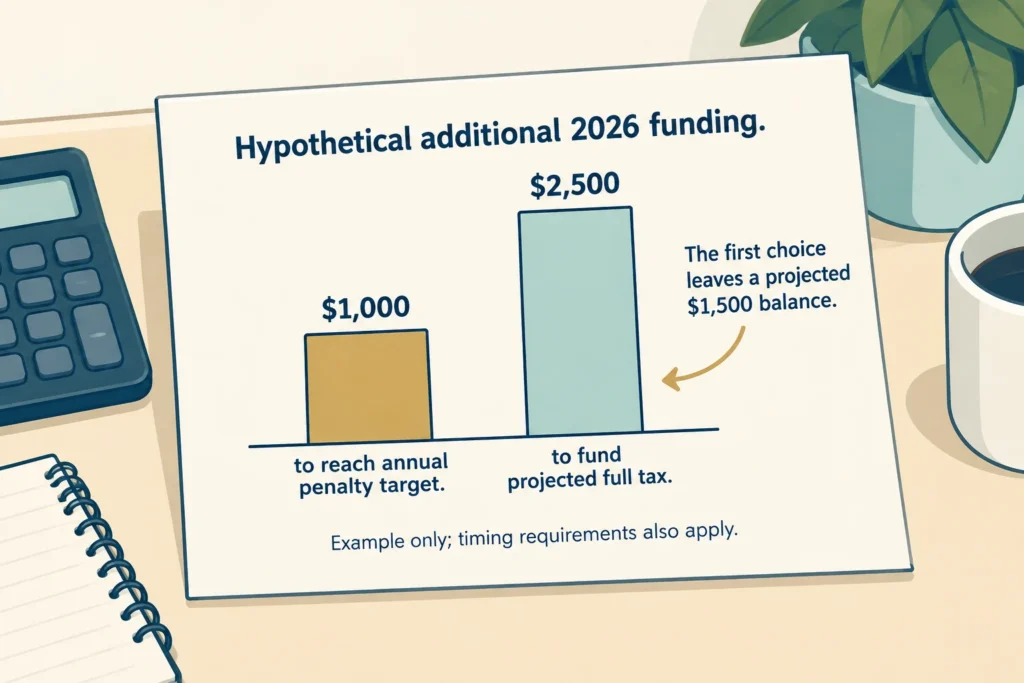
Here is a fictional family: Projected 2026 federal tax is $9,000, qualifying 2025 tax is $7,500, and projected 2026 withholding is $6,500. Assume prior-year AGI below the higher-income threshold, no credits or estimated payments, and ordinary installment rules. The annual penalty-protection target is the smaller of $8,100 (90% of $9,000) and $7,500, or $7,500.[1][2]
| Goal | Additional funding | Extra withholding per paycheck | Projected balance still due |
|---|---|---|---|
| Reach the $7,500 annual penalty target | $1,000 | $200 | $1,500 |
| Fund the full $9,000 projected tax | $2,500 | $500 | $0 |
Choosing the $200-per-check option would leave $300 more in each paycheck than the full funding option, but the projected $1,500 balance would still need to be accounted for in your budget before the payment due date. I would only choose the smaller target with a way to fund the balance. And the $9,000 tax estimate is an assumed input here, not a rate you can apply to your gig earnings.[1][2][4]
Choose where the money will come from
I prefer withholding for its simplicity when wages are steady and the smaller paychecks still cover your bills. Plug your household numbers into the IRS Withholding Calculator. The “extra withholding” box is step 4(c) and you can ignore step 4(a) if your withholding is for self-employment income. Don’t make another adjustment on your W-4 if you’ve already submitted one with the calculator’s recommended changes.[4][5]
The issue with adjusting withholding is payroll may not always process your changes in a timely manner. Before dividing the withholding gap by your remaining paychecks, verify which paychecks can actually carry the adjustment, and look at the first paystub with your changes. Aim for the adjustment in January, and avoid large changes over the course of a year.[4]
Estimated payments work best when the money is in your gig account and your paycheck is already committed to essentials. Using Form 1040-ES, figure out how much you owe and pay using the correct IRS payment channel for the tax year. Keep the receipts. Maintaining a separate tax reserve helps you visualize what is spendable, but the money hasn’t actually been sent to the IRS.[2]
You can also break the job up into a smaller payroll deduction and the rest being covered by estimated payments. Keep both in the same projection. Two payment routes should not be visualized as two different payment amounts that could cover the same gap.[1][2]
A late payment and late withholding aren’t equivalent
In practice, federal withholding is divided equally among the four installment dates, even if a larger amount was withheld in a given year. Estimated payments are counted when paid. You can use the actual-date method for withholding by using Form 2210. Therefore, in some cases, the IRS can allow an equal allocation for federal withholding.[1][3]
For the household in our example, if the total annual withholding was $7,500, it would provide $1,875 for each of the four installments. With only $6,500 withheld, the allocation would be $1,625, or $250 less, per installment. Making a $1,000 estimated payment in late in the year would bring the total withholding for the year to $7,500. However, it would not catch up on shortfalls for earlier years. Extra withholding could help remedy the issue.[1][3]
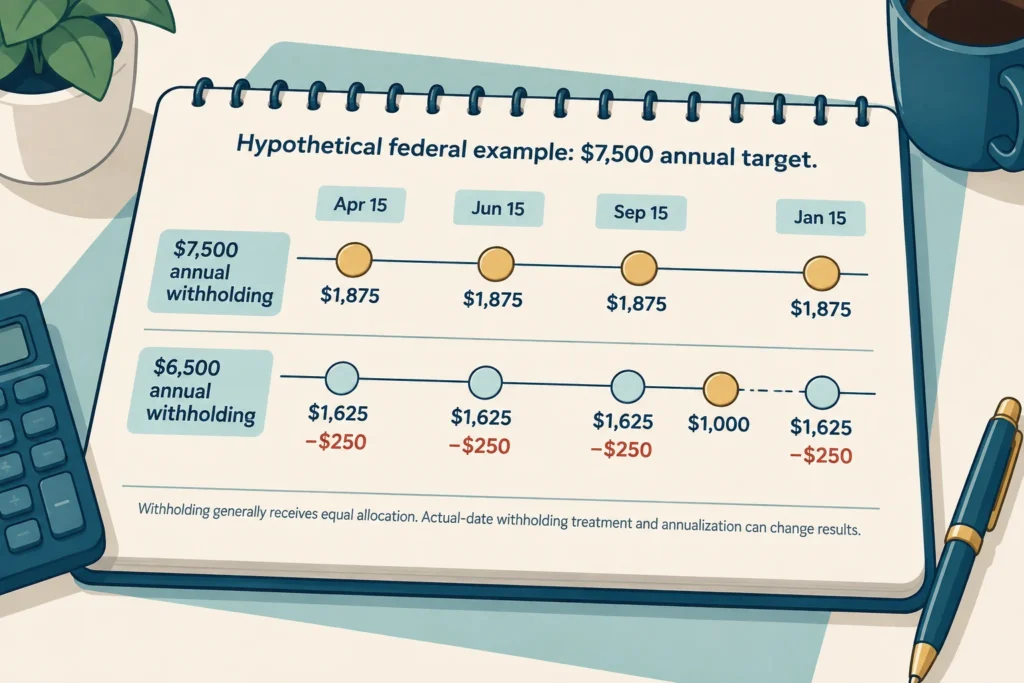
The standard dates for 2026 federal estimated payments are April 15, June 15, September 15, and January 15, 2027. The quarters are not of equal lengths. However, because of certain disaster relief, special rules and relief acts, deadlines can be changed. Also, a filing extension does not mean an extension for payment.[1][2]
When a simple annual estimate needs more work
If you mainly receive your gig economy earnings in the last few months of the year, you may not have to treat your income as if it was earned steadily throughout the year. You can “annualize” your income, which can decrease the amount of required estimated tax payments using the cumulative periods ending March 31, May 31, August 31, and December 31. This method uses your dated income and expense records. It requires the completion of Form 2210 and Schedule AI, and generally means you don’t have to make payments during slow months.[1][2]
State rules can differ from federal rules. For example, with California, the estimated tax payment schedule is 30%, 40%, 0% and 30%. Excess withholding from your federal paychecks probably won’t help you satisfy your state tax obligation.[7]
I would recommend seeking the help of a tax professional to calculate the required payments, especially if you are not paying evenly throughout the year, or if you have income from multiple states, nonresident status, or expect large changes to your tax credits. You should provide your dated income, expense, and payment records. A total at the end of the year does not show if you paid enough along the way, and selecting a payment route will not resolve this.[1][2][5]
Otherwise, put your funding gap next to the paydays and gig payment dates that can cover it. Collecting funds due from payroll before essential expenditures is the simpler of two evils. If not, gig-funded or a combination of estimates with installment deadlines in view will work. I’d rather see an honest amount still to fund than a vague “taxes handled” remark.
Sources and references
- Internal Revenue Service: Publication 505 (2026), Tax Withholding and Estimated Tax
- Internal Revenue Service: 2026 Form 1040-ES and instructions (2026-02-06)
- Internal Revenue Service: Instructions for Form 2210 (2025)
- Internal Revenue Service: 2026 Form W-4 and instructions
- Internal Revenue Service: Tax Withholding Estimator
- Internal Revenue Service: Manage taxes for your gig work
- California Franchise Tax Board: 2026 Instructions for Form 540-ES
- Internal Revenue Service: Self-employment tax (Social Security and Medicare taxes)