

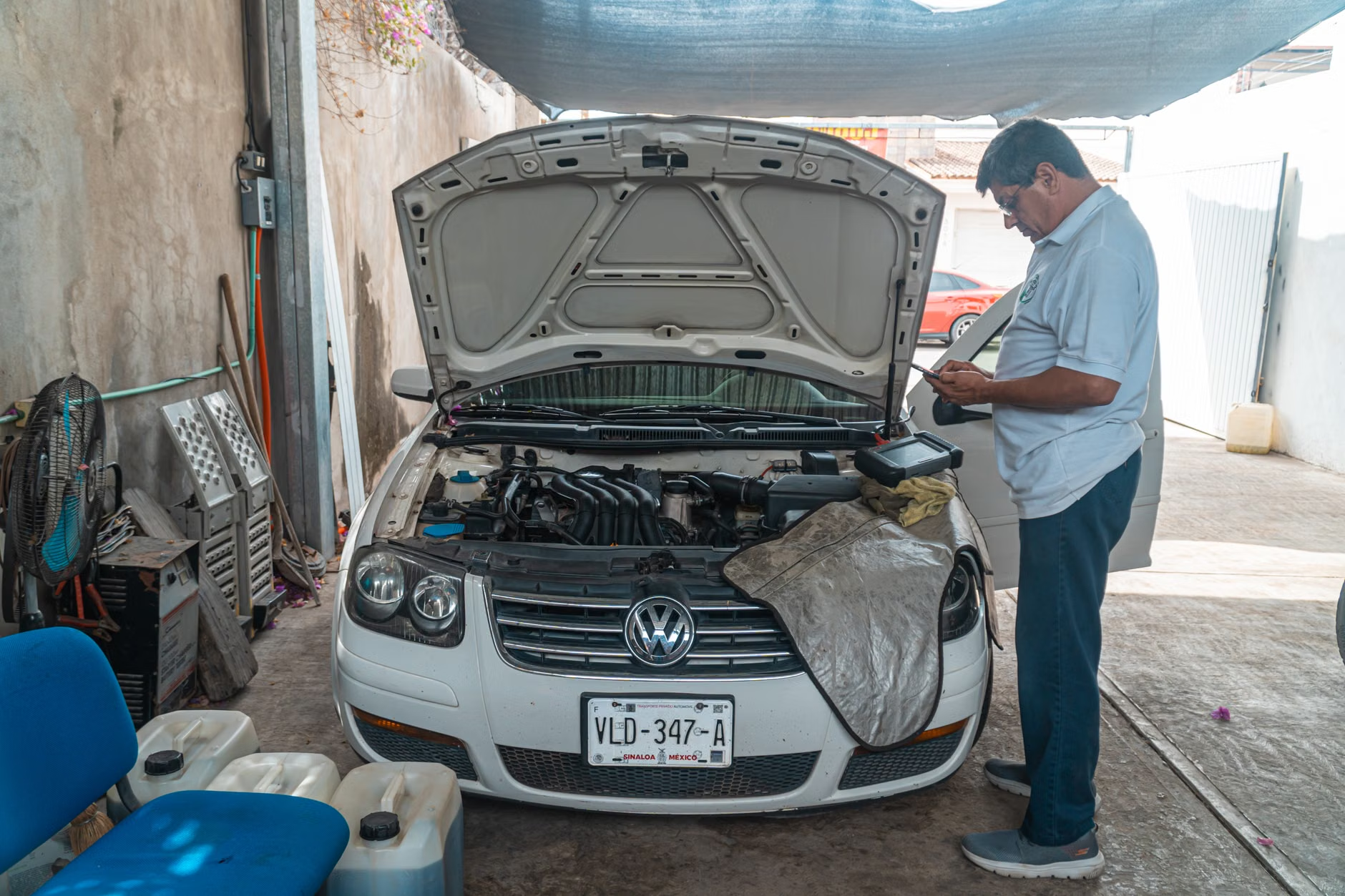
Keep the car if you can afford to pay for the repair, and if, in the long-term, the cost to repair is lower than the cost to replace. Also, consider if you can function without the car during the expected repair time. If you cannot afford to replace the car, and if the cost to repair is lower, you should repair the car. If the cost to repair is not lower than the cost to replace, but if the replacement car would meet your expected needs, you should replace the car. A $2,400 repair versus a $297 monthly payment is not a direct cost comparison. One pays for work now, and the other makes a long-term commitment.
I imagine I'm looking at a lower repair estimate on the car while the reception on my phone shows a replacement for less than $300 a month. Tomorrow's early shift is the snag: the shop needs two days and my usual ride can't help for one. The offer is appealing, but I should ask for insurance on the replacement and see what the loan term would be before taking it for a test drive. I have to get to work, and I don't just need a smaller number.
What does this repair actually buy you?
I would want the shop to break costs down into confirmed defects, scheduled maintenance, and optional cosmetic work. Consider what the repair is fixing, and what remains unfixed. Repeated attempts to fix the same problem is different from different wear items. Worn tires may be an urgent safety concern and routine maintenance. Ask the shop to justify recommended repairs. If multiple things on the car need repair, that is a different discussion from multiple unrelated wear items coming due.[1]
I’d seek a second opinion for a costly repair, even if it means paying for another diagnostic test. Get itemized written estimates and an explanation of diagnostic charges and warranties. Find the shop’s dollar limit for which they will contact you. Determine scheduled work against the car’s maintenance schedule. The FTC suggests you get a second opinion and written estimates because you are buying a specific repair.[1]
If the shop identifies a condition that affects control of the steering or braking system, has a visible structural failure of a tire, or identifies a condition that affects the driving safety of your vehicle, have it towed. Ask the shop to explain what must be repaired to make the vehicle safe to drive. A budget comparison cannot determine if your vehicle is safe or roadworthy.
Put two real cars on the same two-year timeline
Compare the current car with a specific replacement over 24 months and the same mileage. Get an independent mechanical inspection of the replacement, even if it’s warrantied. Get a written report of needed repairs. Inspections and safety reports do not provide a vehicle’s safety. The inspection doesn’t guarantee trouble-free operation, only reduced surprises.[2]
I’d start looking for paperwork at the advertised price, not stop comparing. Find out the out-the-door price and insurance quote for the replacement, as well as the loan disclosures showing the APR, the amount financed, the finance charge, the total amount of payments, the payment schedule, and the payment due date. Factor in fuel, maintenance, tax, registration, and provide substitute transportation on both sides. AAA uses these ownership cost categories, but their averages for new vehicles don’t predict how much your old vehicle will cost to own.[4][5]
Here is a hypothetical comparison, not market quotes. The current vehicle is paid off and worth about $4,000. Both paths cover 24,000 miles over two years. The replacement is $19,200 including purchase taxes and fees, and is purchased with a $4,000 trade, $1,200 cash and a $14,000 loan. At 10% APR for 60 months with no fees, that comes out to about $297.46 a month.
| Cost or value | Keep current car | Buy replacement |
|---|---|---|
| Cash needed now: repair or down payment | $2,400 | $1,200 |
| Loan payments over 24 months | $0 | $7,139 |
| Other repairs and maintenance | $1,800 | $800 |
| Insurance | $1,800 | $3,000 |
| Fuel | $3,000 | $2,700 |
| Ongoing registration and taxes | $200 | $300 |
| Substitute transportation | $400 | $200 |
| Total cash paid | $9,600 | $15,339 |
| Vehicle value after 24 months | $1,500 | $12,000 |
| Loan balance after 24 months | $0 | $9,219 |
Ownership cost doesn’t only include cash paid. The replacement gives you positive equity, meaning the vehicle is worth more than the loan, but you still have a loan. To account for what you start and finish with, use: ownership cost = cash paid + starting vehicle equity, ending vehicle equity.
Keeping costs $9,600 + $4,000, $1,500 = $12,100. Replacing costs approximately $15,339 + $4,000, ($12,000, $9,219) = $16,558. That captures the value used up without counting depreciation or loan principal twice. Don’t add the full five-year finance charge to two years of payments, either, the payments already include those months’ interest.
Keeping wins by approximately $4,458, but replacing costs $1,200 less immediately. That is the uncomfortable reality I wouldn’t want you to miss: cheaper overall can still mean not enough funds to cover it.
Debt doesn’t disappear when you trade the keys
Also, consider your specific situation. Is there a trade-in or purchase offer? A $6,500 payoff for a $4,000 trade-in offer means you’d be $2,500 upside down. You’d have to come up with that cash or, if approved, a new loan, to cover it. Just keep in mind that rolling that into the replacement loan means you’d be increasing your debt, and the new loan would also increase your borrowing costs. The dealer isn’t erasing your previous balance.[3]
Let’s run both paths again starting with an equity of $2,500 (half of the starting equity of $4,000 or $6,500 in each case). For keeping, we have the payments you are already making plus the loan balance at the end of two years. For replacing, we have the cash you pay to close the gap, the new payments, and the new ending loan balance. If the gap is rolled into the new loan, do not count it as cash paid up front. The payoff of the old loan is part of the trade transaction, and not an additional charge that is added on top. This is a different starting situation from the paid off case, and not the entire difference in cost can be attributed to rollover interest.[3]
Can you live through the cheaper option?
Assuming everything else is the same, keeping would still be greater than replacing by about $1,958, if there is an additional $2,000 repair and $500 transportation disruption, in the keeping case. This is not justification to incur an additional $2,500 in repair and transportation disruption costs. If the repair bill is to prevent the eviction from your rented unit, the mathematical difference is of little comfort. It is the same if you receive a rental allowance but there is no available early shift or caregiving route rental.
If you expect to receive cash before your next payday, account for it, and the same for costs you expect to incur during a low income month. In the example, assume other initial costs will be deferred until later (e.g. insurance premiums). You may need to finance the repair of your current vehicle. But if the repair will extend the life of the current vehicle for only a short while, and the repair costs include financing, it is better to put the cost on the keeping path (replacing the current vehicle with a new vehicle), and assume the current vehicle will not last two years.

I’d lean towards keeping when the diagnosis is clear, the repair restores useful service, and you can manage both the cost and the downtime. I’d lean towards replacing when an inspected alternative provides materially better transportation, and its total costs fit, not merely its payment.
A limited repair can buy time, but only if the shop confirms that it addresses the safety defects affecting your intended use. Ask how much useful time it may buy and when the work will be completed. Then determine what transportation you could use if it fails. That’s an estimate, not a promise. Leaving required safety work undone isn’t a bridge.
If neither option leaves you money for essentials, neither is affordable. Get a price for temporary transportation or a lower priced inspected alternative and compare that to a five year commitment. Before authorizing work or signing on the line, determine the repair’s actual scope, the financing terms for the replacement, or how much you’ll have after essential bills. Only then will you be able to evaluate your options.
Sources and references
- Federal Trade Commission: Auto Repair Basics
- Federal Trade Commission: Buying a Used Car From a Dealer
- Consumer Financial Protection Bureau: Should I trade in my car if it’s not paid off?
- Consumer Financial Protection Bureau: What is a Truth-in-Lending disclosure for an auto loan?
- AAA: AAA’s Your Driving Costs