

Before paying a medical balance, verify that the bill is accurate. The insurance claim could still be processing, or the insurance could have denied the claim. Call billing and ask where the insurance claim is. Compare the explanation of benefits (EOB) that the insurance sent to the bill to see if the bill is correct. Ask billing to put the account on a review or payment hold, or a payment plan, if you can’t afford the bill. Protect your money until you resolve this. If the bill isn’t correct, the balance could be waived.
Picture me in an imagined example, opening a hospital bill at the kitchen counter while the insurance portal still says “pending.” Rent is due Friday, and the bill’s payment button offers no explanation. I’m tempted to pay just to get it out of my head. Instead, I write down the due date and call billing. The useful change isn’t feeling certain; it’s getting the unresolved amount and the next deadline into a documented conversation.
If the due date is close, start with billing
You don’t need to resolve the claim in its entirety to contact the billing office. You can tell billing to “place a hold on this account until insurance processes this claim.” Or, “This amount is not correct and does not reflect my EOB.” Identify the service date, state the account balance, and provide the amount in dispute. Ask billing to provide an itemized statement and payment history to see what the balance consists of.
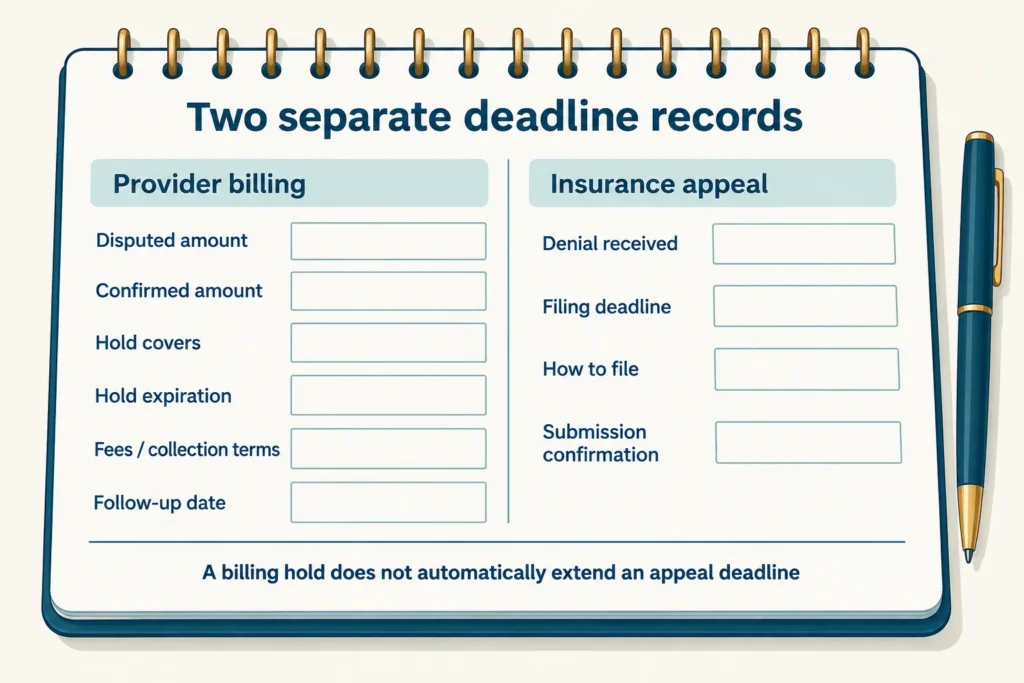
I'd ask next, “Can you hold the disputed amount during review and confirm that in writing?” A note on the account is nice to see, but it doesn't explain what happens on the due date. Ask about which charges the hold covers, when the hold expires, if the account will continue to accrue late fees and possible collection activity, and if the hold stops the account from being turned over to collection. Get a copy of the note, confirmation via the provider's portal, or get written confirmation.
A complaint alone isn’t an extension. [Providence’s published policy](https://www.providence.org/billing-support/faq), for example, pauses formal collection attempts after written billing concerns until it responds. That isn’t a nationwide entitlement. If your provider refuses a hold, ask a billing supervisor about an extension or arrangement before the deadline, and save the response along with names, dates, and reference numbers.[3]
Find out what actually happened to the claim
"Insurance hasn't paid" doesn't help much. Was the claim submitted? Is something missing? Is it still processing? Has it assigned the cost to your deductible? I'd ask for the claim number, status, missing info, and who will act on it next. "Working on it" is not very helpful.
| What you find | Next contact and question |
|---|---|
| Insurer has no matching claim | Provider billing: Was it submitted to the correct insurer with the correct member information? Ask for submission details. |
| Claim is pending or being reprocessed | Insurer: What is missing, who must supply it, and when should you check again? Ask billing for a hold meanwhile. |
| Processed EOB and provider balance disagree | Provider billing: Have insurance payments, contractual adjustments, and your prior payments been posted? |
| Claim was denied, or the coverage/network decision looks wrong | Insurer: What reason or remark code applies, and does this require a corrected claim, an appeal, or both? |
| Balance matches, but you cannot afford it | Provider assistance office: What assistance and payment arrangements are available for this account? |
Compare the same services, not just the totals
The EOB is not a bill and doesn't always explain the full story. Compare charges based on who billed you (the provider) and the patient. Also, match dates for the service and check the claim number, if any, for the service. Be aware that for one patient visit, you may receive multiple bills (i.e., hospital and physician).
Now look at billed charges, the allowed amount, contractual adjustments, insurance payments, and patient responsibility, including the remark codes. [CMS recommends checking your share against the EOB](https://www.cms.gov/initiatives/your-patient-rights/medical-bill-rights/get-help/medical-bill-guides-resources/check-your-medical-bill-errors). Duplicate service lines, unfamiliar services, or missing payments and adjustments deserve a call. Matching totals are useful, but they don’t prove the insurer made the right coverage decision.[1][2][4]
For an in-network example, let’s say the provider billed $1,000. The provider then contracted $400, leaving an allowed amount of $600. The insurance company paid $450, leaving $150 in patient responsibility. Let’s say you paid $50 toward this claim. At this point, you would expect the provider to be collecting the remaining $100. A $500 bill would leave a $450 discrepancy.
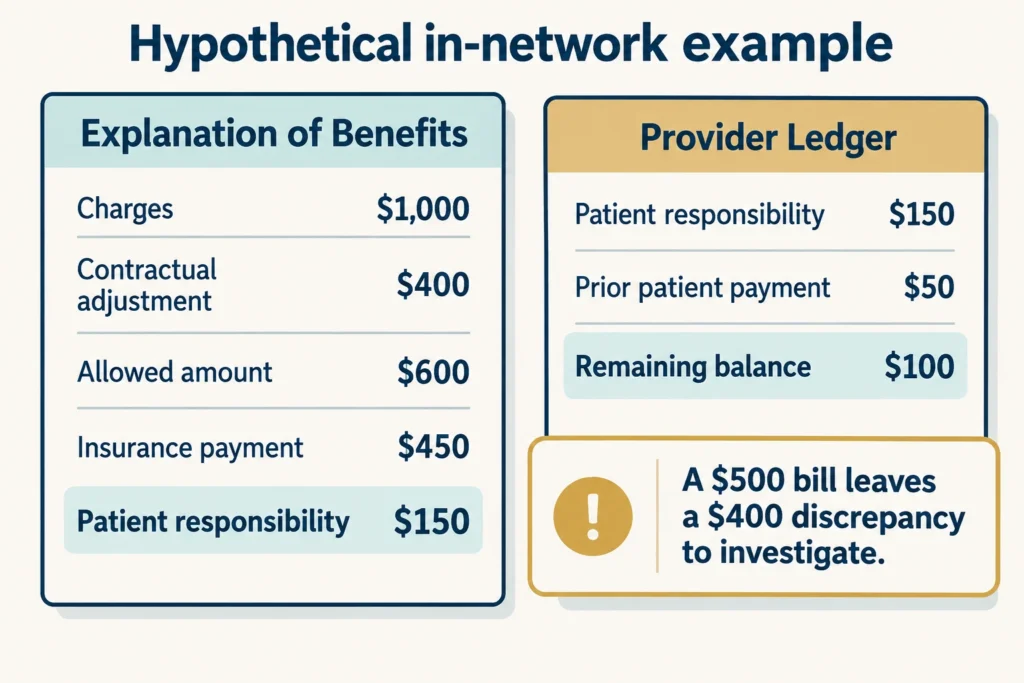
That last $50 is easy to miss. [CMS notes that an EOB may not reflect what you already paid](https://www.cms.gov/initiatives/your-patient-rights/medical-bill-rights/get-help/medical-bill-guides-resources/how-read-health-insurance-explanation-benefits). I’d check the provider’s ledger against your receipt, rather than pay the same share twice, or subtract it twice if the bill already credits it.[1]
Keep the confirmed amount separate from the disputed amount
If billing confirms that $100 is owed and you agree, you can consider paying it while disputing the other $400. Get agreement first about where the payment will go and what happens to the disputed remainder. I prefer that agreed split to sending a token payment and hoping the system understands. A partial payment alone doesn’t necessarily stop collection activity.
Keep the insurer’s appeal deadline separate from the billing follow-up date. [HealthCare.gov describes a 180-day internal-appeal deadline](https://www.healthcare.gov/appeal-insurance-company-decision/internal-appeals/) after you receive a denial for coverage addressed by its guidance. Check your denial notice for the plan’s filing method and deadline, because public programs have different procedures. A corrected claim or billing hold doesn’t prove your appeal was filed or extend its deadline. Ask for proof of filing.[4][9]
If you have employer sponsored insurance, the benefits office can tell you who handles the appeal (the insurer or plan), and if the plan is self-funded. The insurer’s logo on your denial of coverage doesn’t answer that. A state Consumer Assistance Program can help with a denied appeal. If the account has already been turned over to a collection agency, ask what their process is to address the disputed debt and the time frame in which they need your response. If you have legal papers served on you to respond to a collection action, that is also a demand for you to respond to a court order. Providing a request for provider review may answer that court order, but it may leave other orders of the court unaddressed.
An out-of-network surprise deserves another check
With most private insurance, the [No Surprises Act](https://www.cms.gov/initiatives/your-patient-rights/medical-bill-rights/know-your-rights/insurance) limits certain out-of-network bills for emergency care, certain care at in-network facilities, and air ambulance services. Ground ambulances generally fall outside the federal protections. Exceptions, notice-and-consent rules, and state law can change the answer, so ask the insurer how the protections apply to your service or call the federal No Surprises Help Desk at 1-800-985-3059. A large deductible alone isn’t prohibited surprise billing.[7]
One distinction is worth keeping straight: because you used insurance, the [federal good-faith-estimate dispute process](https://www.cms.gov/initiatives/your-patient-rights/medical-bill-rights/get-help/dispute-bill) for uninsured or self-pay patients isn’t your remedy. Its collection restrictions don’t automatically protect an ordinary insured billing dispute.[8]
A correct bill can still need financial assistance
You don’t have to finish the accuracy dispute before asking for help paying. Some providers, including Providence, offer assistance to eligible insured or underinsured patients. Request the policy and application, then check income and asset criteria, required documents, and which bills it covers. Under [tax-exempt hospital assistance rules](https://www.irs.gov/charities-non-profits/financial-assistance-policies-faps), the policy must identify covered and excluded separately billing providers. Hospital approval won’t necessarily reduce a physician’s separate bill.[3][6]
[IRS rules for tax-exempt hospitals](https://www.irs.gov/charities-non-profits/billing-and-collections-section-501r6) generally provide at least 120 days after the first post-discharge bill without extraordinary collection actions and at least 240 days to apply for assistance. A complete application during the applicable period requires suspension of extraordinary collection actions while eligibility is decided. Those protections matter, but they aren’t universal payment extensions or bans on ordinary bills and collection contacts. Ask billing separately what will happen to your account while the application is reviewed.[5]
I wouldn’t turn a questionable bill into credit-card debt just to quiet the reminders. If you’re considering installments, ask about interest, fees, total repayment, due dates, missed-payment consequences, and whether assistance can still reduce the balance. Then compare the proposed payment with what you need for rent, food, utilities, and other essentials. If it doesn’t fit, tell billing that amount is unaffordable and ask for a lower payment or assistance review, not a plan you can only keep for the first month.
Sources and references
- Centers for Medicare & Medicaid Services: How to read a health insurance explanation of benefits
- Centers for Medicare & Medicaid Services: Check your medical bill for errors
- Providence: Frequently Asked Questions, Billing Support
- HealthCare.gov: Internal appeals
- Internal Revenue Service: Billing and collections, Section 501(r)(6)
- Internal Revenue Service: Financial assistance policies
- Centers for Medicare & Medicaid Services: Know your medical bill rights when using insurance
- Centers for Medicare & Medicaid Services: Dispute a medical bill
- Centers for Medicare & Medicaid Services: Action Plan: Health insurance plan denied a claim
- Consumer Financial Protection Bureau: Medical bills sent to collections