

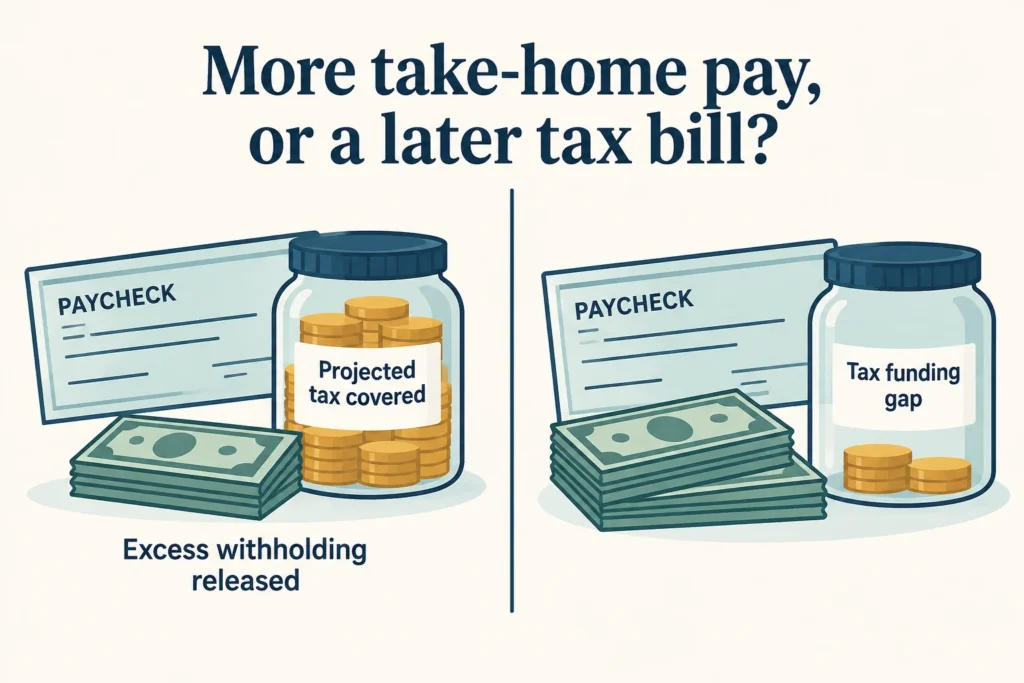
Yes, if you can see from your current house tax estimate that you’re over withholding. Otherwise, reducing your withholding doesn’t resolve the shortage; it just moves part of it to tax time. I’d look for legitimate overpayments before assuming a bigger paycheck means more after-tax dollars.
Imagine I'm at the kitchen counter, opening the payroll portal while a utility reminder sits beside my phone. The extra-withholding field looks wonderfully easy to erase. I'm annoyed that the bill needs money now, but I leave the field alone long enough to check whether those dollars are excess payments or taxes I'll still owe.
Which paycheck deduction can a W-4 actually change?
Look at the line on your paystub that says “Federal Income Tax.” Your W-4 tells your employer how to calculate that prepayment. It doesn’t change your tax liability, and it also doesn’t impact your regular Social Security and Medicare taxes, which are governed by a separate set of rules for payroll.
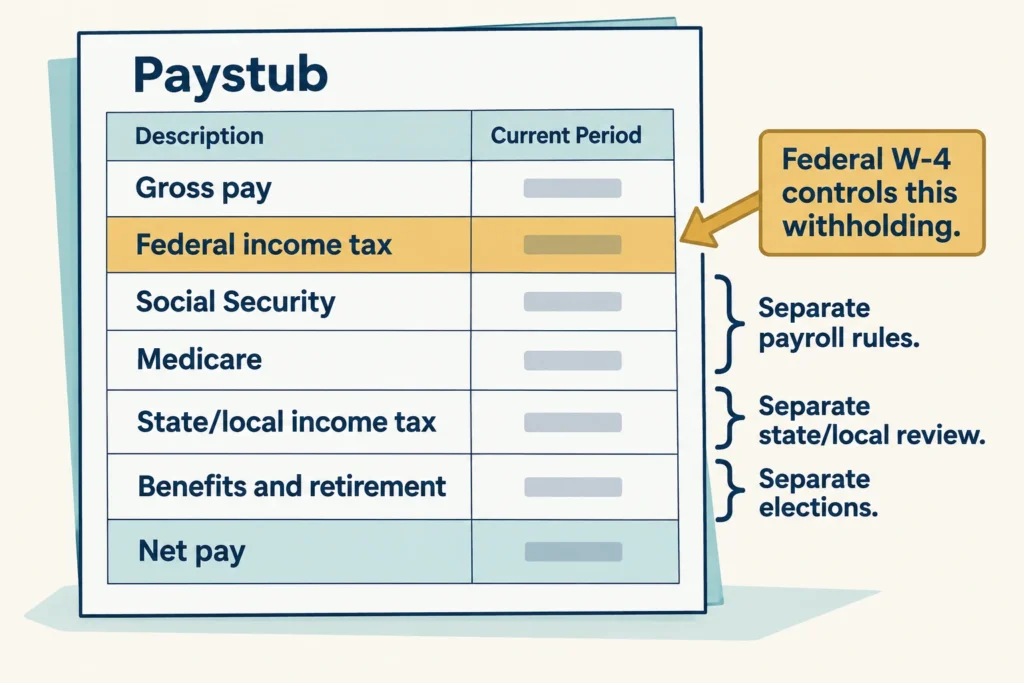
Contributions for health insurance and retirement are determined by other forms, and a W-4 has no impact on those. State and local income tax withholding also needs to be evaluated separately. For New York, for example, you would use Form IT-2104. A federal withholding estimate doesn’t help you determine if your state tax prepayments are adequate.
If your federal withholding is already $0, then there’s nothing to release on that line. Also, last year’s refund isn’t a good indicator; last year’s refund could have been a refundable tax credit, not an overpayment of tax. Splitting your tax refund by your pay periods can trick you into thinking you’ll have that cash at each pay period.
One paycheck isn't the whole tax picture
Use the IRS Tax Withholding Estimator along with recent pay stubs from your job, your last tax return, your expected income, deductions, and credits. If you file jointly, be sure to include your working spouse's pay and withholding. Two jobs can each withhold as though they're your only job unless your W-4 accounts for both, a tidy-looking paystub can still leave you short on tax.
Filing status, bonuses, overtime, interest and other income also affect the estimate. I wouldn't chase a dollar-perfect result when your remaining earnings or credits are uncertain. Keeping a modest cushion may spare you from a cash-flow problem at tax time. The rules and examples here are for the 2026 tax year. Use the forms and estimator instructions for the year you are adjusting.
What $100 more per paycheck would really mean
Take a hypothetical employee whose only income is wages. For 2026, assume this employee's estimated total federal income tax is $4,500 with no other estimated payments or refundable credits. Take this tax estimate as given. Assume the employee has already withheld $3,600 and has six pay periods left after the change is made.
| Amount | Keep current W-4 | Remove existing extra withholding |
|---|---|---|
| Projected annual federal tax | $4,500 | $4,500 |
| Federal withholding already paid | $3,600 | $3,600 |
| Withholding per remaining paycheck | $250 | $150 |
| Withholding across six remaining checks | $1,500 | $900 |
| Projected full-year withholding | $5,100 | $4,500 |
| Projected overpayment | $600 | $0 |
The employee still needs to prepay $900: $4,500 in projected tax minus $3,600 already withheld. Across six checks, that's $150 per check. Suppose current withholding consists of a $150 baseline plus $100 of extra withholding entered in W-4 Step 4(c). Removing that existing extra amount releases $600 without leaving the assumed tax bill underfunded.
I appreciate the additional $100 per check. But if the employee began with a $240 paycheck shortage, that still leaves a $140 deficiency. Eliminating that $140 by cutting it from necessary payroll tax payments would only hide that deficiency, not eliminate it.
The money comes from future checks
Step 4(c) is for the additional withholding amount on each pay check, not the total you want withheld. In this case, eliminating the extra amount works, because the remaining baseline withholding covers the remaining tax. If other entries on the W-4 need adjusting, use the estimator’s suggestion. Don’t falsify exemptions, dependents, or deductions to produce the paycheck you want.
A new W-4 won't send previous withholding back through payroll. It only changes paychecks going forward, and not necessarily the next one. Your employer is required to implement the changes you request no later than the first payroll period ending on or after the 30th day from when they received your request.
Ask payroll which check will reflect the change before you count on that money. Use that date to help determine how many checks you have remaining, and compare the new pay stub to your estimates. If payroll did make an error, ask about correcting that error. A new W-4 won't affect the pay periods prior to the one requested.
Don’t check the 2026 exemption box just to receive a tax refund, or because money is tight. Exempt means that you had no federal income tax liability in 2025 and expect none in 2026.
No penalty doesn't mean no bill
You may hear that you just need to satisfy a “safe harbor.” That means payments reach the smaller of 90% of the current-year tax or 100% of the prior-year tax. The prior-year percentage rises to 110% if prior-year adjusted gross income exceeds $150,000, or $75,000 if you're married filing separately. The prior return must cover 12 months. The payment timing and crediting rules still apply, and there are special rules for certain taxpayers.
Usually, if your total withholding and credits are less than $1,000, you don't need to pay estimated tax. Paying 90% of the example’s $4,500 tax still means a balance of $450 at filing. If you can't find a credible source to support that $450 is available to you now, I wouldn't count it.
Other things that trigger an adjustment of your tax estimate include a change in your marital status, job, or number of dependents. You also need to reconsider if your or your spouse’s income, deductions, or credits changes. Recheck a late year adjustment in January. Withholding already paid in January helps this year's tax calculation, but you start the new year without those payments.
Most important, with your latest pay stub and estimator, figure out what your tax is with your current income and if there is a pay raise or other change. If essential bills can’t be paid, use the remaining gap to prioritize bills and ask for workable payment arrangements. I don't want you to wait to make changes until your W-4 is changed.
Sources and references
- Internal Revenue Service: IRS Tax Withholding Estimator
- Internal Revenue Service: 2026 Form W-4 and instructions (2025-12-08)
- Internal Revenue Service: Publication 505 (2026), Tax Withholding and Estimated Tax
- Internal Revenue Service: Publication 15 (2026), Employer's Tax Guide
- Internal Revenue Service: Tax Withholding Estimator FAQs
- New York State Department of Taxation and Finance: 2026 Form IT-2104, Employee's Withholding Allowance Certificate