


A paycheck advance can be helpful if the money gets to you before the payment due date and if there are no immediate consequences for using it. You have to evaluate the offer by the state of your finances after payday, not just the fact that you were able to pay a bill today.
Picture me, in an imagined example, opening an advance app beside a utility bill due tomorrow. The deposit looks like an escape hatch. Then I notice the repayment lands before my grocery trip and a car-insurance withdrawal. My relief fades a little; instead of accepting immediately, I write those payments beside the smaller payday balance. That’s the view I want you to have before tapping.
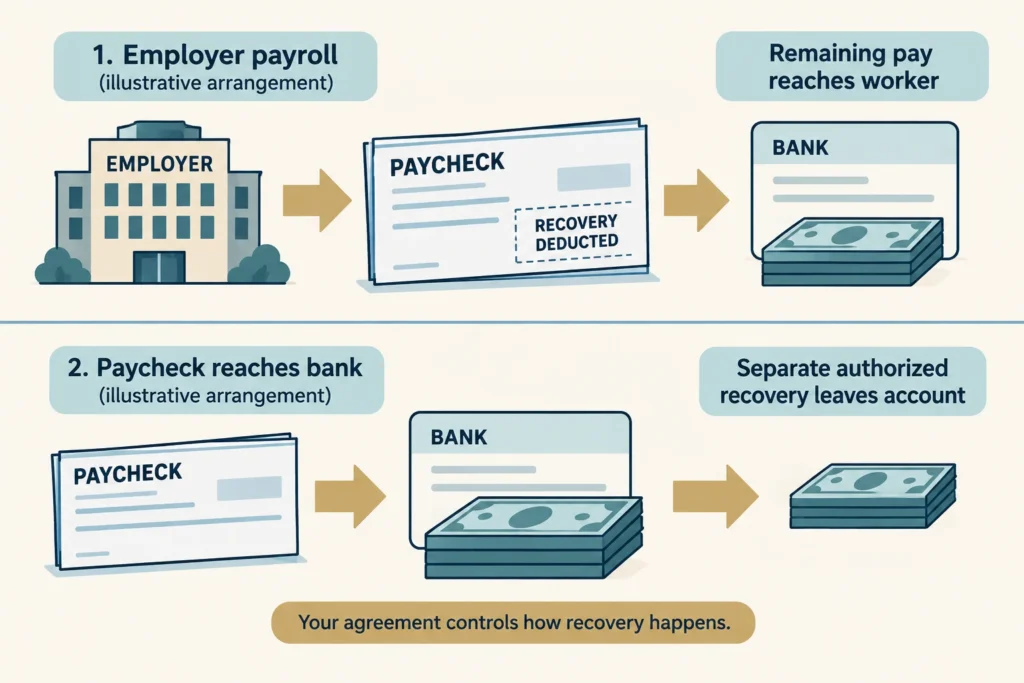
Find out where repayment comes from
The important difference isn’t the name on the app. It’s where repayment comes from. An employer-linked service may deduct it through payroll or receive your paycheck and send you the remainder. DailyPay, for example, describes its payday payment as final net pay minus early transfers and fees. A timecard correction or larger payroll deduction can leave you having accessed more than your final pay supports.[2]
Consumer apps usually access your bank account via ACH transfers, but categories like EarnIn and Brigit implement recovery mechanisms in different ways. Brigit’s optional payroll direct deposit has similar issues to PayActiv’s optional wage access. With any of these, I would want to know the amount, date, account, and the consequences of a failed payment, as well as how many times the app would attempt to recover the money, before agreeing to anything. A number of folks feel better seeing a full paycheck in their account, but it can be disconcerting if part of it is already spoken for.[3][5]
Price the money you’ll actually receive
Look at the cost of the dollars you need when you need them. A $200, $10 fee advanced dollar with a $210 repayment would be $190, not a lot of help for a $200 bill.
Paying for speed may be reasonable if slower delivery would miss the deadline. But I wouldn’t pay for instant money when the free transfer arrives in time. DailyPay’s supplied terms list $0 next-business-day ACH and instant transfers at $1.99 or $3.99, depending on the employer arrangement. Use the price and delivery options displayed for your transaction.[1]
A tip belongs in your cost calculation if you choose it, not in a list of unavoidable fees. EarnIn says tips are optional and don’t affect Cash Out eligibility or size. Subscriptions are a separate choice: Brigit lists $8.99 Plus and $15.99 Premium plans, but also offers a route for eligible users to request an advance without subscribing. That route doesn’t promise immediate approval or processing. If you subscribe, count the renewals too.[3][4][5]
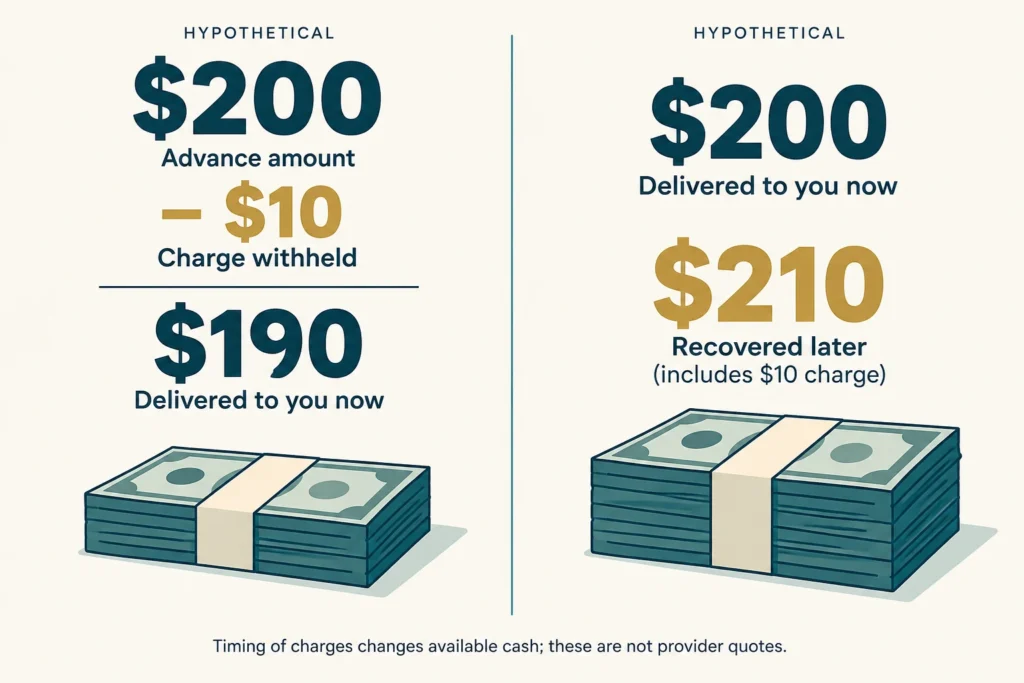
If you already have a subscription, break this request's cost out from your total monthly cost for the service. No additional transfer fees is not free. Add any plausible overdraft fees or returned-payment fees, it may be a bank fee rather than a provider fee, but your bank balance doesn't care.[4][5][9]
For a frame of reference, a $10 fee to receive $200 7 days early is a 5% cost. Annualizing it is approximately 261%: $10 ÷ $200 × 365 ÷ 7. That's a comparison calculation, not necessarily a legally required APR, or an estimate of your anticipated spending over a year. The actual fee is a $10 charge, that is what you need to pay.
What will the next two paydays leave you?
What matters is cash on hand plus take home pay, minus repayments and everything you need to cover before your next pay day. Consider other outstanding advances, essentials, minimum obligations, pending withdrawals, and irregular expenses. Don't consider the bill this advance has already paid. I'd rather work with a conservative paycheck, than find out the plan relied on your best week.
The following changes the answer. Consider the following two families starting with no buffer, using a $200 advance to pay today's bills, and charging a $10 fee upon recovery. They both receive $1,200 each payday, and their expenses stay the same in both scenarios.
| Cash-flow check | Timing gap closes | Recurring shortfall grows |
|---|---|---|
| Expenses per pay cycle | $900 | $1,250 |
| First payday after $210 recovery | $1,200, $210, $900 = $90 left | $1,200, $210, $1,250 =, $260 |
| Before the following payday | No further advance needed | Assume a new $260 advance covers the shortage, with another $10 charge |
| Following payday | $90 carried forward + $1,200, $900 = $390 left | $1,200, $270, $1,250 =, $320 |
I’d be comfortable calling the first advance a bridge loan: once repaid, you’d have $90, and the following cycle wouldn’t require any new borrowing. The second household is already $50 short at the start of each cycle due to charges. A free advance can’t eliminate that deficit.
The number of times you use the app doesn’t tell you which household you resemble. You might have enough income overall but poorly timed due dates. That requires a different response from when your expenses exceed your income and the calendar, not the number of times you use the app, shows the difference.
A balanced cycle can still have an empty Tuesday
There’s another problem: even if you have enough money overall to cover the costs, you might not have enough on the day you need to make the payment. A debit can occur before payroll is made available to you and cause a shortage or bank charge. I wouldn’t bet on rent that the provider makes a same-day posting order. You should always assume a payment will be made on the scheduled date unless you confirm otherwise.
Regulation E of the Electronic Funds Transfer Act allows you to give your financial institution a stop payment order at least three business days prior to the scheduled date of the transfer. That doesn’t apply to all one-time authorizations or payroll deductions. Stopping a debit doesn’t eliminate your obligation to pay, and deleting the app doesn’t eliminate the debt. In the agreement, EarnIn states that a pending debit will occur even after you close your account.[3][9]
Compare the alternatives that can actually arrive in time
I would call the biller before paying for speed: “Can I pay this amount on payday, and what fees or service consequences would remain?” Extensions or partial payments help only if the biller accepts them. Ask for confirmation of the current bill’s treatment; changing due dates for future bills may not excuse a payment for a past due bill and could change the amount of the next bill or the fees charged.[10]
An advance from employer may be fee-free and cheaper, though it still reduces your usable pay later. Repaying the advance from savings may be a better choice, since the savings avoid a fee, and you still have money to use in an emergency. You may be able to get a small-dollar loan from your credit union and spread the payment out further, but only some credit unions can do that, and funding may not be in time to help you. You may want to check what your total charges will be, and compare how much you’ll actually have available next cycle, and how much you’ll have to pay the next cycle. The cheapest option next cycle may not pay a bill due this cycle.[11]
The legal label doesn’t settle the money question
As of October 3, 2026, the CFPB’s December 2025 advisory opinion treats defined “Covered EWA” as outside Regulation Z credit and withdraws the unfinalized 2024 proposal. Its coverage depends on conditions involving accrued wages, payroll recovery, nonrecourse protections, and no credit-risk assessment. It isn’t a blanket exemption for every advance app or an answer to every state-law question.[6]
State protections differ. Nevada requires a no-cost access option and specified disclosures, with bank-fee reimbursement when recovery is attempted before the disclosed date or for an incorrect disclosed amount. That doesn’t promise reimbursement for every overdraft from a correctly scheduled recovery. Check your state financial regulator’s EWA licensing and consumer-protection information rather than assuming Nevada’s rules apply to you.[7][8]
Depending on the date and amount of the next payment you need to make, an advance may be reasonable. If you can make it to the next payday with the money you've advanced, it may have bridged the gap. If not, take the actual shortage into account when you request payment relief. Saying “I’ll be $260 short after repayment. Can we arrange a payment I can cover?” shows the bank your situation and says you need to make a payment, but you can’t. If you say payment relief is needed and say what you need, it shows the bank your situation, and the money may be available for you to take.
Sources and references
- DailyPay: On-Demand Pay Program Terms
- DailyPay: How does payday work for DailyPay users?
- EarnIn: Cash Out User Agreement
- Brigit: How much does Brigit cost?
- Brigit: Terms of Service
- Consumer Financial Protection Bureau / Federal Register: Truth in Lending (Regulation Z); Non-application to Earned Wage Access Products (2025-12-23)
- Nevada Legislature: NRS Chapter 604D, Earned Wage Access Services
- Nevada Financial Institutions Division: Earned Wage Access Providers
- Consumer Financial Protection Bureau: Regulation E § 1005.10, Preauthorized transfers
- Consumer Financial Protection Bureau: Request a change in your bill due date
- National Credit Union Administration: Access: Financial Inclusion & Community Support