

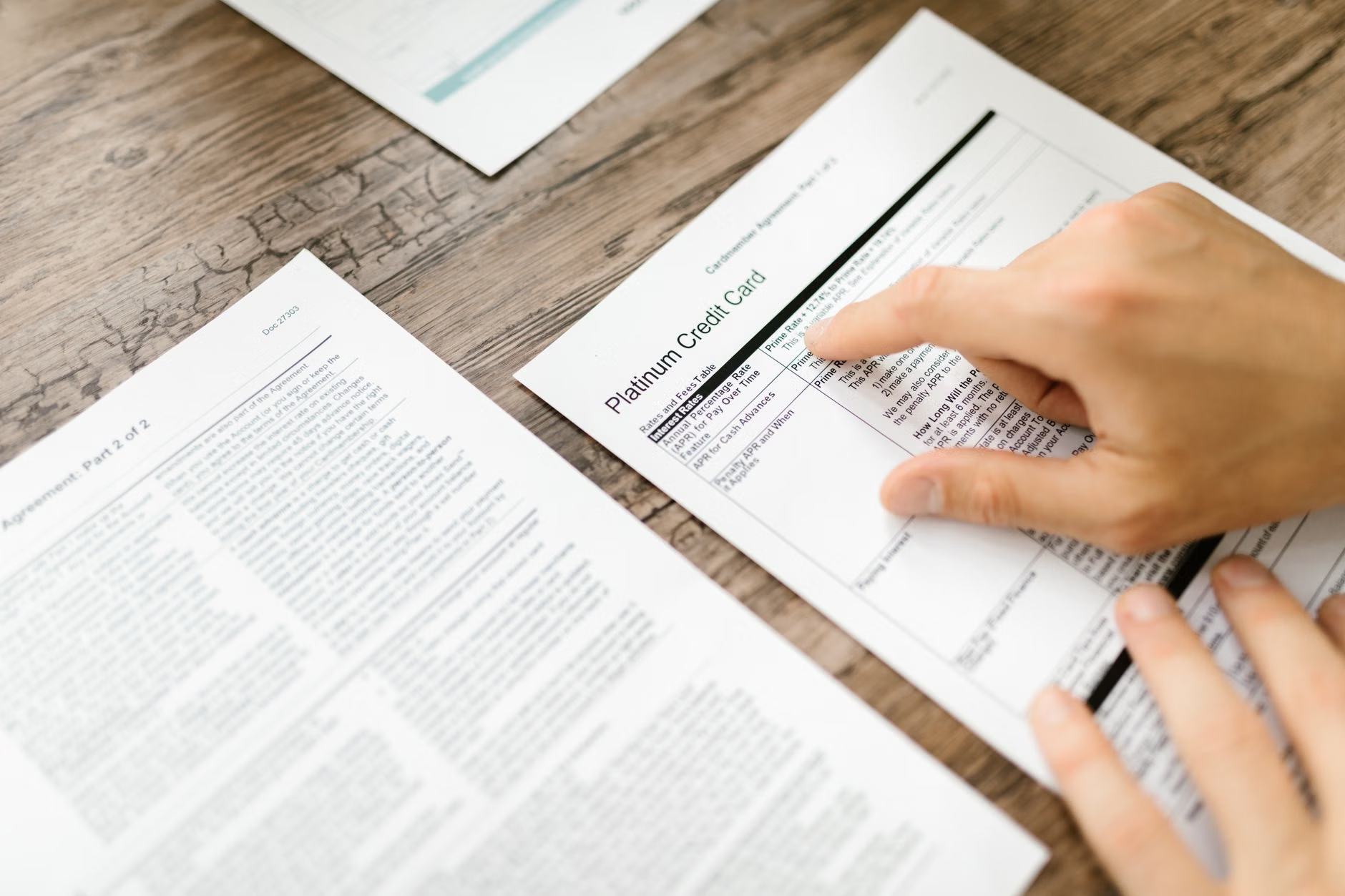
Turning off overdraft protection for your debit card does not prevent fees for other types of transactions, such as checks, ACH transactions, or recurring card transactions. Your account terms may still allow fees for these types of transactions. Generally, you should not incur an overdraft fee for transactions at an ATM or a point of sale that you have not affirmatively elected to process. If you do, you may request that your financial institution correct the error. Posting a transaction to your account does not justify a charge for that transaction.
I’d start with the payment attached to the fee, not with whether you remembered the setting correctly. The irritating part is that an app can call several different transactions a “debit.” That tells you money left the account, not which protection applies.
The payment type matters more than the toggle
| Payment | Does the opt-in fee protection apply? | What to check |
|---|---|---|
| ATM withdrawal or one-time debit-card purchase | Yes. Without affirmative opt-in, the bank cannot charge for paying a covered overdraft. | Consent records, effective opt-out date, and the payment tied to the fee. |
| Recurring debit-card payment, such as a subscription | No, not under this particular protection. | Recurring classification and the account’s overdraft terms. |
| Check or ACH withdrawal using your account information | No, not under this particular protection. | Whether the bank paid or returned it, and the applicable fee schedule. |
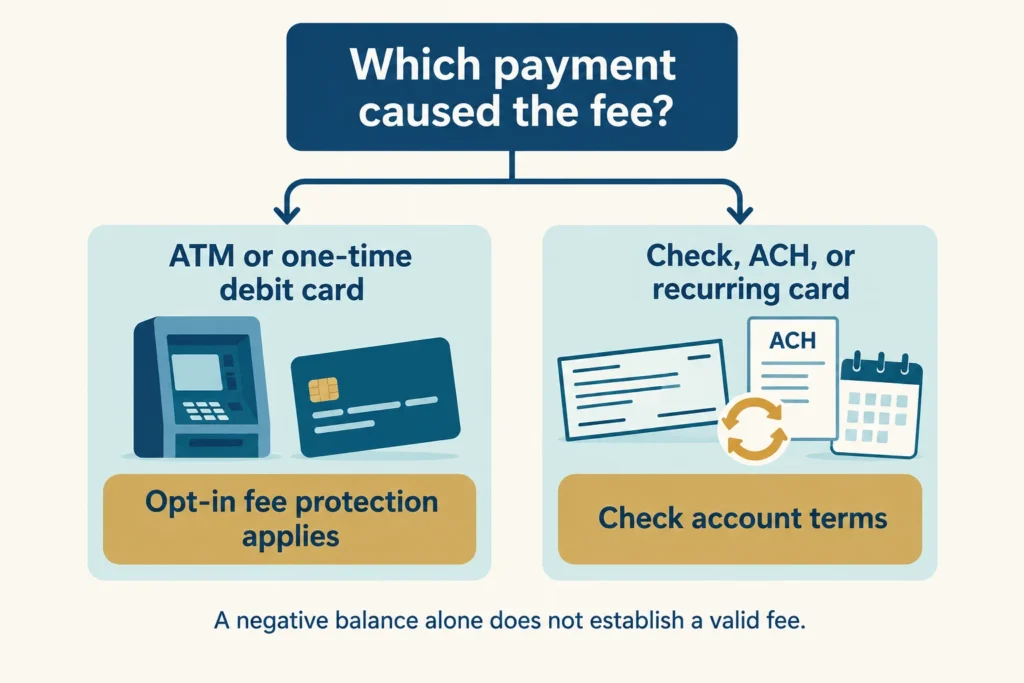
It is similar for one time card purchases. Routing and account numbers generally mean the payment is via ACH. An automatic subscription charged to your card may be recurring. If the application doesn’t say, ask your financial institution to determine if that payment is recurring. Bank classification systems should be relied on to classify a transaction, and surprise classifications should be investigated.
Imagine I’m opening a fee notice while breakfast gets cold, then hunting through an app that labels both groceries and a subscription “debit.” I’m annoyed: I switched this off. Instead of toggling more settings, I save the notice and ask which payment caused the fee and whether it was recurring. The switch’s name isn’t enough to answer that.
There’s another wrinkle: opting out doesn’t guarantee that every covered payment will decline. A card purchase can still settle and leave you negative. The rule limits the fee for paying it, so “the purchase posted later” can explain the balance without explaining why the bank was entitled to charge you.
Was the payment paid, returned, or something else?
An overdraft fee generally follows a payment the bank paid despite insufficient funds. An insufficient-funds, or NSF, fee generally follows a payment it returned unpaid. A merchant might separately charge a returned-payment fee. Those are different charges, and I wouldn’t dispute one using the rules for another.
Check your bank’s current practices and the terms effective when the charge occurred. Some banks no longer charge NSF fees: Chase’s June 14, 2026 deposit agreement, for example, says it does not charge a bank fee for returning an item unpaid. That doesn’t erase a merchant’s charge or tell you what another bank does. A linked-savings transfer fee is different again; linked-account transfer services are excluded from this particular overdraft-service rule.
Follow the balance without counting a purchase twice
A pending card hold can reduce your available balance before the purchase appears in your posted balance. When the purchase posts and the matching hold releases, it isn’t a second purchase. Here’s one hypothetical timeline using Chase’s June 14, 2026 terms for an eligible account, assuming no other activity.[4][5]
- Monday: You start with $100 posted and $100 available.
- A $40 one-time card purchase becomes pending: $100 posted, $60 available.
- Tuesday: The purchase posts and its hold releases. Both balances are $60, not $20.
- The bank then pays a $130 ACH bill, leaving the account negative $70.
- If you don’t meet the applicable deposit deadline, an eligible $34 overdraft fee leaves the account negative $104.
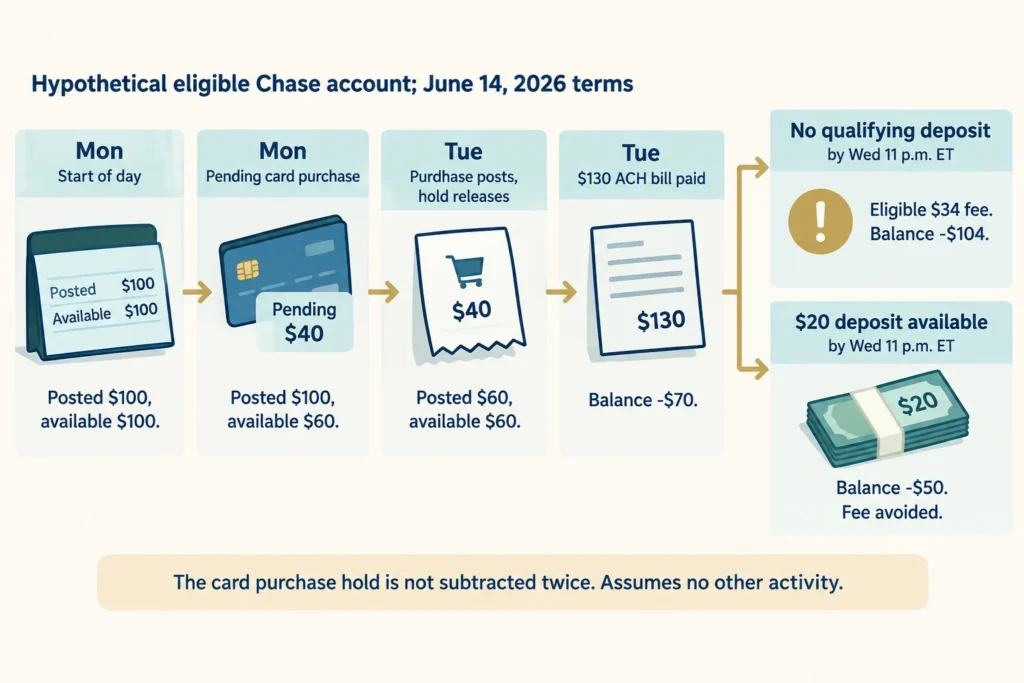
Here, the ACH bill is the potential fee-bearing payment. Under those Chase terms, bringing the account to no more than $50 overdrawn by 11 p.m. Eastern the next business day avoids the fee. A $20 deposit available by Wednesday’s deadline takes this balance from negative $70 to negative $50. A deposit still on hold doesn’t do the job, and another debit increases what you need.[4][5]
I’d want that amount and deadline before moving scarce cash. Your account may offer a different grace period or none at all, so ask: “How much must be available, and by when, to avoid another charge?” That’s more useful than being told simply to add money.
Ask what the fee was for, and keep the records
- The fee notice: exact name, amount, date, and any payment it identifies.
- Surrounding account history: deposits, pending holds, posted payments, and returns.
- Your opt-out confirmation and effective date. On a joint account, ask about consent or changes made by either owner.
- The bank’s underlying payment type, recurring classification, and balance used to assess the fee.
- The fee schedule and deposit-agreement provision effective on the charge date, including any grace period or threshold.
You don’t need to argue from memory. Try: “Please identify the payment this fee relates to, whether it was paid or returned, and the account provision allowing the fee. My debit-card overdraft opt-out took effect on [date]. If this was a covered one-time card payment, please correct the fee and any resulting charges.” The effective date matters: revocation must be implemented as soon as reasonably practicable, but changing the setting today doesn’t automatically undo earlier fees.
If the charge matches the terms, I’d ask separately for a courtesy refund. That’s discretionary; a correction request identifies an error. If the notice instead names a daily or sustained negative-balance fee, ask which payments created the shortfall. Regulation E limits those fees too, and a balance caused by both covered and noncovered payments needs closer review. If the bank won’t resolve a documented concern, you can submit a CFPB complaint with your records and its response.
Change the safeguard that missed this payment
If a recurring bill caused the fee, the useful change may be its withdrawal date, not another card setting. Ask to move it after your income becomes available, or use manual payment if you can reliably track the due date. I’d set a low-balance alert above the next automatic withdrawal, rather than at zero. It won’t block the bill, but it may give you time to arrange a date change. Linked savings can help only while it has usable money, and transfer fees belong in that comparison.
When a payment is made automatically that is not approved, contact the company to withdraw authorization to make the payment, contact the bank to have the payment stopped, and keep records of all of this. To stop a preauthorized payment, you must contact your bank at least three business days prior to the payment date. Your bank may require written confirmation within 14 days, and may charge you a stop payment fee. A payment that has been initiated may be processed after the stop payment order is issued, and stopping the payment does not cancel the debt.[6][7]
If you did not give permission to make the payment, then you must report this as a transaction dispute rather than a request to waive a fee. I’d keep the debit card opt-out in effect and ask, “What change would prevent a fee on this payment type, and would the payment then be returned?” Knowing if your next payment will be processed is as important as avoiding the bank fee.
Sources and references
- U.S. Government Publishing Office: 12 CFR Part 1005, 2026 edition, § 1005.17 and official interpretations
- Consumer Financial Protection Bureau: § 1005.17 Requirements for overdraft services
- Consumer Financial Protection Bureau: What can I do if my bank charged me a fee for overdrawing my account? (2025-01-02)
- JPMorgan Chase Bank, N.A.: Additional Banking Services and Fees for Personal Accounts (2026-06-14)
- JPMorgan Chase Bank, N.A.: Chase Deposit Account Agreement (2026-06-14)
- Consumer Financial Protection Bureau: How do I stop automatic payments from my bank account? (2026-08-31)
- Consumer Financial Protection Bureau: § 1005.10 Preauthorized transfers