

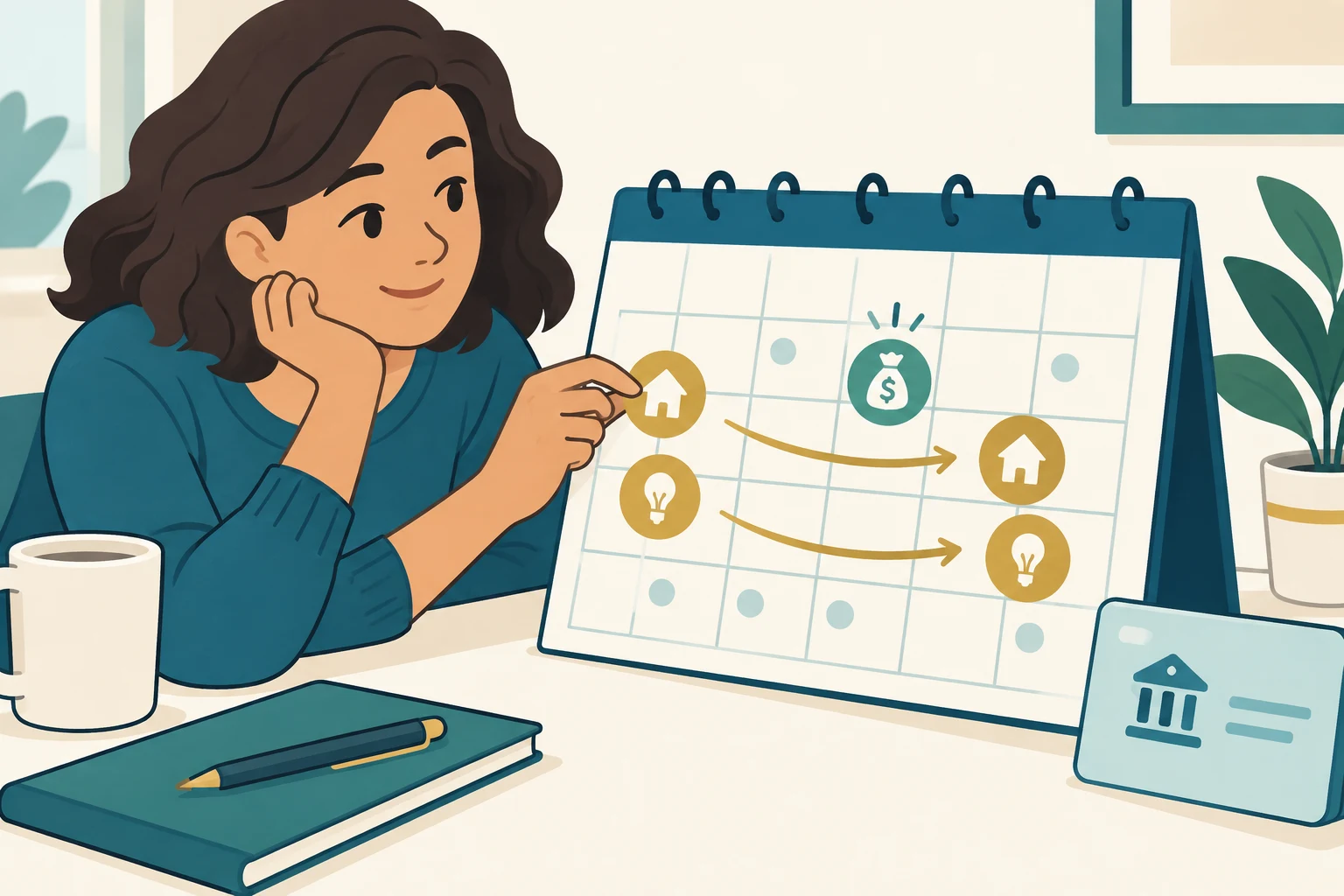
Some companies allow you to adjust bill due dates to account billing dates. Usually, you have to request this account feature. Typically I try to time the bills that cause the largest gaps between paydays, but only after I check when the change will occur and how much I’ll have to pay during the adjustment.[1][3]
Imagine I’m at the kitchen table with a payday marked Friday and three withdrawals marked Thursday. The monthly total works, but the checking balance doesn’t. I’m annoyed by another reminder to “budget better,” so I stop rearranging spending categories and circle the two payments I could ask to move. The problem is a date, not a missing lecture.
Put the money-out dates next to your paydays
Take the money you expect to have available at the start of the month, and subtract anticipated expenses in order. Include expected bill payments, expected withdrawals (including ATM withdrawals) and anticipated purchases (like grocery purchases). I want to know the lowest expected balance along the way. I need to see Thursday’s payment.[2]
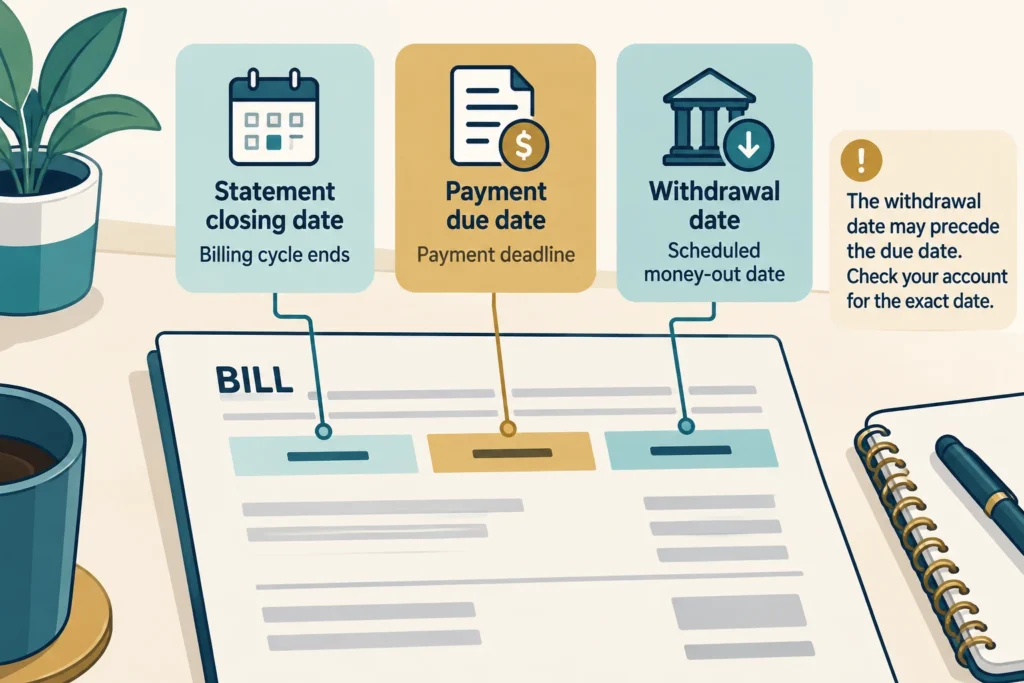
Use the date money actually leaves your account. That’s different from the due date, deadline, and a credit card’s statement closing date. One exception to this rule is T-Mobile. They say AutoPay is set to withdraw money around two days before the due date. Also, an “X”-dated bill can still need funding on an earlier date. So, you need to check your account to see when they’re scheduled to take the money.[6][9]
What moving two payments changes
This example starts with $1,100 and gets $1,500 on the 6th and 20th. Monthly expenses total $2,830, so that leaves a surplus of $170. The original schedule shows a shortage of $180 before payday. The revised schedule moves a $180 card payment from the 3rd to the 8th and a $100 phone payment from the 4th to the 9th. The rest of the schedule stays the same.
| Date and cash movement | Original balance | Revised balance |
|---|---|---|
| Starting available cash | $1,100 | $1,100 |
| 1st: rent, $1,000 | $100 | $100 |
| 3rd: card, $180 originally | , $80 | $100 |
| 4th: phone, $100 originally | , $180 (lowest) | $100 (lowest) |
| 6th: paycheck +$1,500 | $1,320 | $1,600 |
| 8th: revised card payment, $180 | $1,320 | $1,420 |
| 9th: revised phone payment, $100 | $1,320 | $1,320 |
| 10th: everyday spending, $400 | $920 | $920 |
| 12th: utilities, $200 | $720 | $720 |
| 20th: paycheck +$1,500 | $2,220 | $2,220 |
After that, both schedules are the same. On the 22nd, there's $600 of everyday spending, leaving $1,620, and on the 26th, $350 of other bills, leaving $1,270, at the end of the month. Paying the next month's $1,000 rent leaves $270. Changing the payment dates doesn't create money. It prevents payment from being made before it's funded.
You don't always have to make both adjustments. Moving just the card payment changes the lowest balance from $180 to $0. Moving the phone payment also changes it to $100. I'd prefer the extra wiggle room if it doesn't alter beneficial discounts or add costs that are greater than the value received. $100 doesn't cover the modeled payments. It does cover the slight increase in groceries. The $100 probably isn't the right buffer for all households.
Test several actual upcoming pay cycles, especially if you’re paid every two weeks: those paydays move relative to fixed monthly dates. Choose dates based on when cash is deposited and withdrawn, rather than assuming every bill is paid on payday.
Which providers might let you move a bill?
Check your account's billing or payment settings, your agreement, or the service provider's official pages. If the option isn't clear, contact billing support. The examples above illustrate my point of not assuming that a service provider gives all of their customers the same deal.[1]
- Credit cards: Capital One says a due-date change takes effect within four to six weeks. Until then, the minimum is still due by the current statement date.
- UTILITIES: Southern California Edison states timing can be at the beginning, middle or end of the month, as opposed to giving an exact date. They state they will allow one additional change in a 12 month period, and the change is usually reflected on the next billing statement, but could take two billing cycles.
- PHONE SERVICE: T-Mobile's published policy states they require six months of on time payments in order to allow one change of the due date per account for life. T-Mobile cautions customers of closely spaced payments, a larger bill for the majority of accounts, and the loss of Military, Company, Organizational and/or Government Agency discounts. It is recommended that you contact them to find out which discounts your account is eligible for.
- Insure: GEICO announces a Pay Bill Later option for some AutoPay customers to postpone their next payment. This is not the ability to change the date you pay your bill to a different, more convenient, day.
The first adjusted bill needs its own calendar
The first bill you'll want to check most closely is the adjusted bill. Depending on how the provider affects the change, the payment interval or billing period could become longer or shorter. There is also the risk that you could end up with two payments that are unusually close together. Also be sure to ask for the first two payment amounts, the effective billing cycle, and if there are any fees, changes to discounts or prorated charges. Put the payments on your calendar, especially the first two, and not just the attractive dates in the future.[1][5]
Finally, there is also a cost to check the balance on a credit card that carries a balance and charges interest. Because interest is generally calculated on a daily basis, you could end up paying interest on previously purchased items that were protected by an applicable grace period. To find out more about how your changed cycle would affect your balance, contact your credit card company.[8]
If you are unable to fund the transition, pause the change and request to speak to someone about a one-time arrangement and its associated costs prior to the due date. Payment schedules don’t change what is past due. Moving payment dates does not change what is owed and doesn’t replace the resources needed to meet financial obligations. Prioritizing or reducing financial obligations is the only way to meet financial commitments if resources are not available. I wouldn’t look to a calendar to solve that problem.[1][2]
Before you rely on the new dates
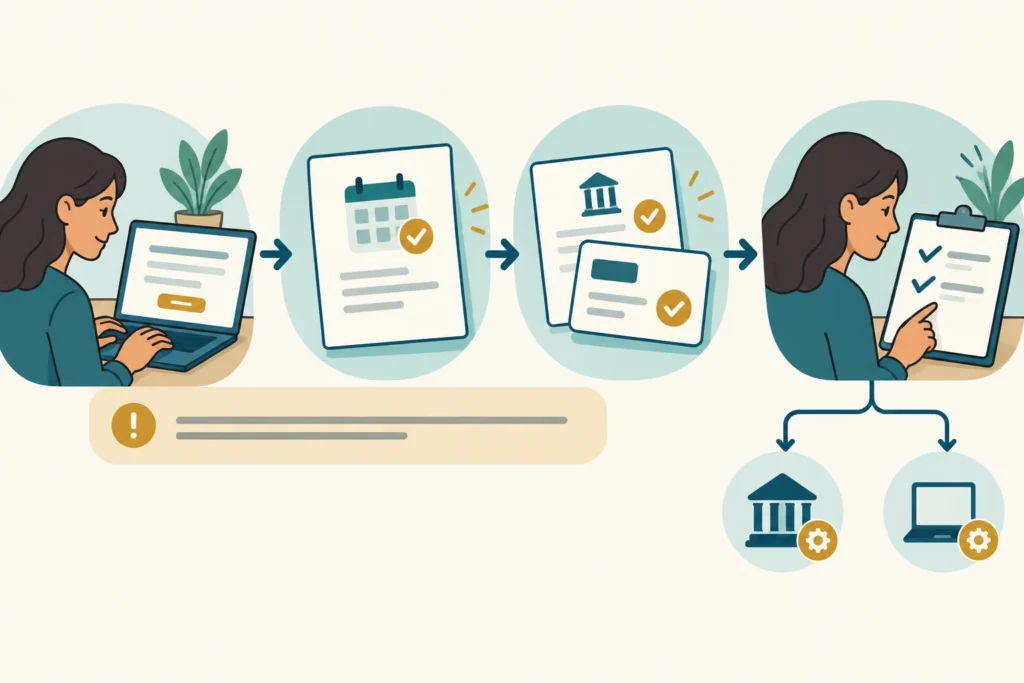
- State your request for the scheduled payment you desire and ask if that changes the due date, withdrawal date, billing cycle, or just one payment.
- Obtain written confirmation for the change, the effective billing cycle, what is still due, the next two amounts and due dates, as well as changes to interest, fees, and discounts.
- Separately check your AutoPay status from your bank’s bill pay or standing transfers. See if AutoPay follows the bank change. Ask if a manual payment stops a scheduled payment.
Don’t cancel all payments or assume a payment that is pending disappears.
- Keep the current payment funded until you confirm a replacement. Then, if you used bank payment control, update the payment instructions to stop a payment (which may take a few days to process).
Check for duplicate payments.
- Compare the first scheduled debit and the confirmation. If they do not match, contact the billing support before the earlier scheduled payment.
Sources and references
- Consumer Financial Protection Bureau: Request a change in your bill due date
- Consumer Financial Protection Bureau: Creating a cash flow budget
- Capital One: Making credit card payments
- Southern California Edison: Choose your bill's due date
- T-Mobile: Your bill and what's impacting it
- T-Mobile: AutoPay
- GEICO: Frequently Asked Questions For Auto Policies
- Consumer Financial Protection Bureau: How does my credit card company calculate the amount of interest I owe?
- Chase: What is a Closing Date on a Credit Card?