


Review your options for financial assistance before financing, and compare written offers for the same remaining medical balance. I tend to favor hospital plans that are genuinely interest-free, as long as the payments work with your cash flow, the fees and cancellation terms are acceptable, and the plan fits your budget. “Hospital payment plan” doesn’t ensure affordable financing, and a small minimum payment on a medical card doesn’t explain the true cost of no interest.[1][3]
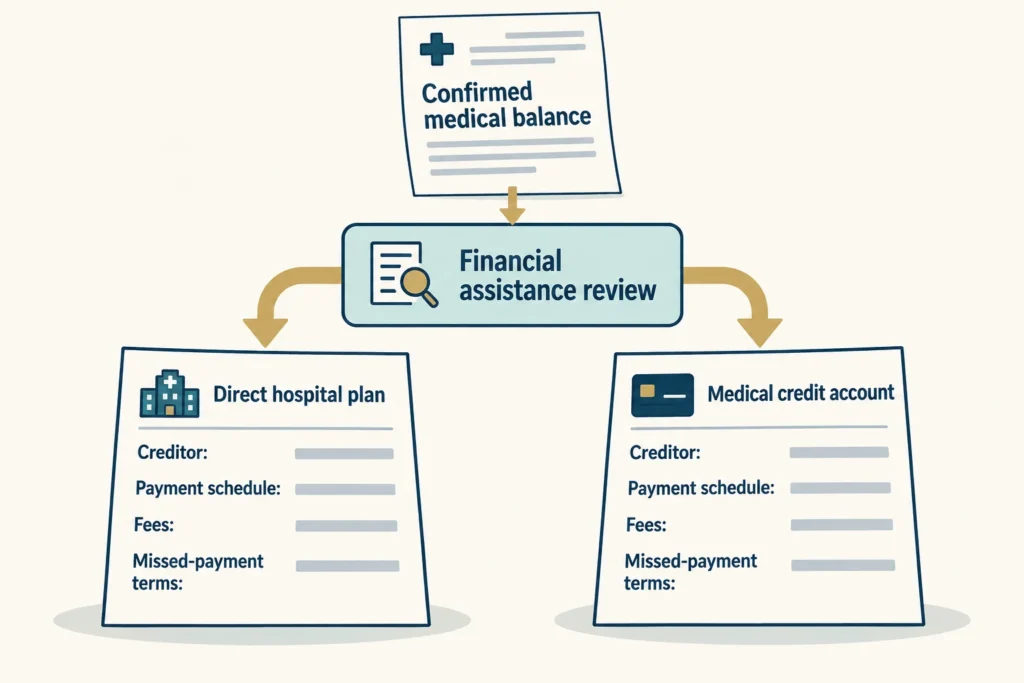
Picture me, in an imagined example, looking at financing paperwork while my phone flashes a reminder that rent is due Friday. The patient wants to get this medical bill off their “to do” list, and the low payment is appealing. Then the patient notices the “if paid in full” option. The patient puts down the pen and asks for the hospital’s terms and the payoff deadline. That one little word deserves more emphasis than the large print payment.
Reduce the bill before choosing how to repay it
Assuming you’ve confirmed the amount you owe, request the hospital’s financial-assistance policy and application. Offering assistance reduces your balance, and a payment plan doesn’t reduce the amount you owe. A genuine, interest-free plan over a payment plan that charges interest should be more appealing.[1]
Tax exempt hospitals under Section 501(r) have written financial-assistance policies for emergency and medically necessary care, and must have written policies for eligibility and application. Not all hospitals must have a written financial-assistance policy. It’s important to determine if services and the clinicians involved are covered, as a hospital’s policy may not cover all of the clinicians that work at the hospital.[2]
Find out if the billing and collection activities can be put on hold while you review your situation. Get the answer and any deadline in writing. Charging the bill can create a problem with the assistance application process, but the CFPB states you can still apply for assistance after you pay. I wouldn’t assume the charge would be reversed and the lender’s obligations cleared. Ask how a reduced balance would reach your account.[1]
Find out who you would actually owe
The person providing the financing may work for the hospital and the creditor may be a bank or financing company. Ask “Does this keep the balance with the hospital, or open a separate credit account?” Some provider agreements may charge service or administrative fees and/or interest. The logo on the paperwork may not be the answer.[1]
For both of the offers described, use the balance after any assistance or discount is applied. Get the down payment, payment dates, number of payments, the APR, and all fees. Ask for the payment schedule needed to clear the balance by the promotional deadline. For a card with variable minimums, request the schedule needed to clear the balance by the promotional deadline, not just the first minimum. Be aware, comparing the variable minimum payment and the amount needed to clear the balance by the promotional deadline is where the deal may fall apart.[1][3]
“No interest if paid in full” is not true 0% APR
With a deferred interest offer, interest does accumulate during the promotional period, but if you meet the payoff conditions, that interest is waived. If you don’t pay off the promotional balance, the interest that has been accumulating will be charged to the account on the purchase date. This balance reflects the balance you have carried over time, not just the original purchase amount multiplied by an APR.[3][4]
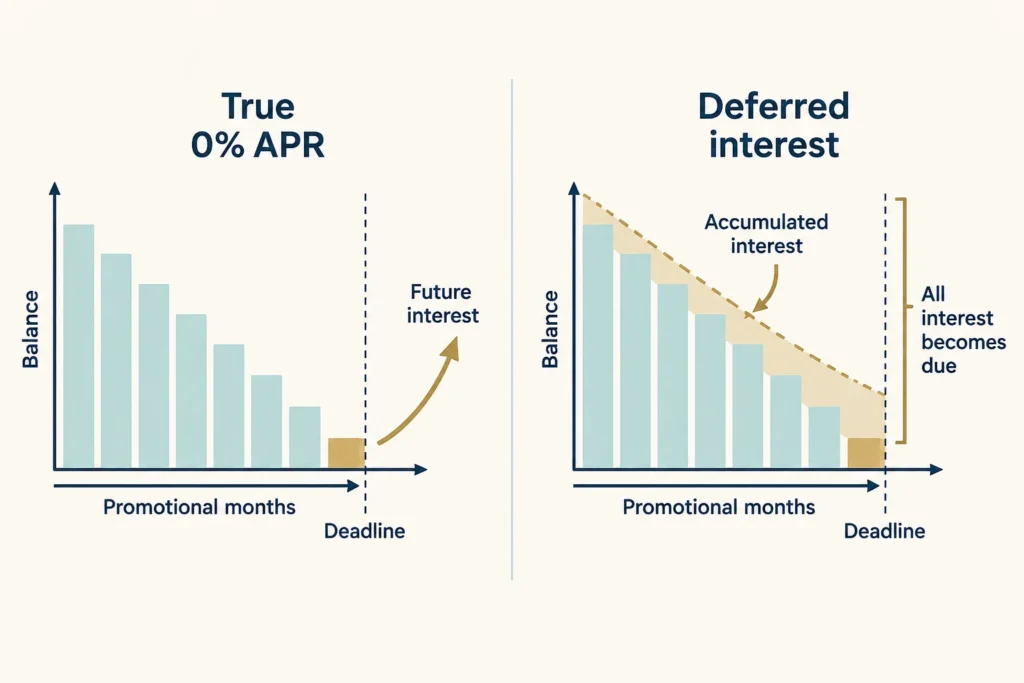
True 0% APR offers don’t charge interest during the promotional period. After the offer, the regular interest rate will be charged on the balance and will continue to accrue on any previous unpaid balances. Deferred interest offers allow cardholders to not pay interest during the promotional period, but if the balance isn’t paid in full by the end of the promotional period, the entire balance (not just the remaining balance) will be charged interest.[4]
Get the exact expiration date; it may differ from your regular payment due date. Count the payments you can actually make before it, preferably leaving room to finish early. If the card has other balances, ask how payments will be allocated. Sending enough money overall doesn’t necessarily mean enough reaches this promotion.[3]
What a $2,400 balance really asks of your budget
Suppose the confirmed balance is $2,400 and a deferred-interest offer gives you 12 usable payments. Assume no fees, other balances, new charges, or payment-allocation complications. The March 2026 CareCredit agreement’s ordinary minimum formula includes the greater of $30, 3.25% of the new balance, or 1% plus current interest and late fees, with additional amounts where applicable. Under these assumptions, the first minimum would be $78. Your actual offer may differ.[5]
| Payment approach | Monthly amount | What it accomplishes |
|---|---|---|
| First card minimum under the example assumptions | $78 | Meets the initial minimum, not the promotional payoff target |
| Keep paying a fixed $78 for 12 payments | $78 | Pays $936; leaves $1,464 in principal |
| Clear the balance in 12 payments | $200 | Pays the full $2,400 before expiration, if all payments arrive in time |
| Repay over 24 interest-free payments | $100 | Pays the full $2,400 over two years |
The fixed-$78 row isn’t a forecast of future statements; it shows why the first minimum is a poor payoff guide. Cleveland Clinic provides a real comparison: its published interest-free options include a 24-month term beginning at a $2,250 balance, subject to eligibility. For $2,400, that works out to $100 monthly before any separately applicable fee. Confirm fees rather than treating “interest-free” as “fee-free.”[5][6]
If you have a hypothetical $180 available each month after essentials, existing obligations, and irregular expenses, the $100 plan fits; the $200 promotional payoff does not. Even twelve $180 payments leave $240 unpaid. I’d choose the direct plan under those assumptions if its remaining terms are acceptable. A card approval doesn’t supply the missing $20 each month.
Ask what happens in a bad month, before signing
Interest-free hospital plans can still have sharp consequences. Cleveland Clinic says it cancels plans when the monthly minimum isn’t received within 60 days; canceled-plan balances cannot enter a new plan, and collections balances are excluded. Ask your provider when cancellation occurs, whether the remaining balance becomes due, and when it may go to collections. Those terms could outweigh a modest cost difference.[6]
Get the late fee, post-promotion APR, terms and conditions for losing promotional treatment, and consequences to your credit report. Medical credit account delinquencies can impact your credit. The CareCredit agreement provides an example of a 32.99% APR for purchases. It's important to understand your true APR and not assume that the quoted APR would be the APR you would pay.[1][3][5]
Before signing either agreement, ask to have the balance adjusted for any assistance you are eligible to receive. Also request the name of the creditor, all fees, the full repayment schedule, the promotional period (if any), and what happens if you miss a payment. This should be in writing. Compare the payment dates provided to you with your pay dates to determine if you can afford to make the payment. If you cannot make the payment provided to you, request a different payment or extension and do not sign the agreement.
Sources and references
- Consumer Financial Protection Bureau: What should I know about medical credit cards and payment plans for medical bills? (2023-05-08)
- Internal Revenue Service: Financial assistance policies (FAPs)
- Consumer Financial Protection Bureau: Deferred-interest purchase repayment guidance
- Consumer Financial Protection Bureau: How to understand special promotional financing offers on credit cards (2017-06-08)
- Synchrony Bank / CareCredit: CareCredit Credit Card Account Agreement, revision March 2026 (2026-03)
- Cleveland Clinic: Zero Interest Payment Options