

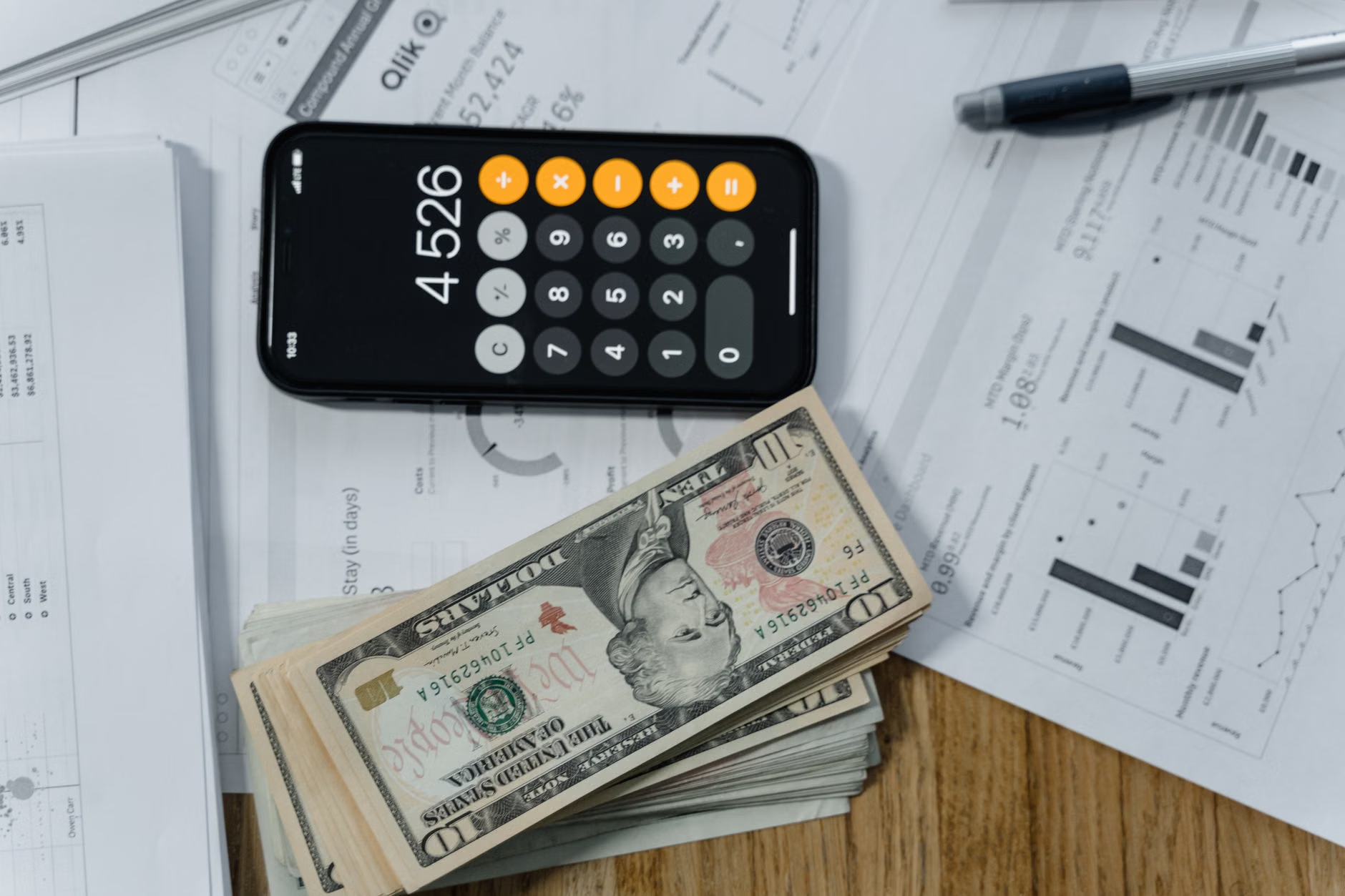
Tap into surplus savings to pay down debt, but not so much that you’re left with no cash cushion. Consider partial repayment: it can help cut down the interest you’re paying without forcing you to choose between repayment and the ability to pay your rent. It’s important to consider what the money left behind still needs to do.
Some of that savings may already belong to a bill
In one hypothetical situation, I’m about to make a payment when I remember I have an insurance renewal on my kitchen counter. I’m a bit annoyed: the savings balance looked generous until I remembered what it had to cover. I leave the payment where it is to avoid a false sense of security.
Your available savings is what you have after essentials and predictable expenses. Don’t subtract a bill twice. An annual insurance premium or estimated tax payment doesn’t become available for debt repayment just because you’ve labeled your fund “emergency fund.”
Undeducted money still covers uncertainty. The CFPB states emergency savings depends on situation. Looking at unexpected costs and cash flow could help set savings goals. I would rather price a surprise paycheck or a larger cash flow interruption than hand over a one dollar bill and say that covers your savings.[1]
Put a price on keeping some cash
Here’s one hypothetical household, held constant across three choices. Savings total $6,500, but $1,500 is set aside for known bills that are not covered elsewhere. The remaining $5,000 is uncommitted cash. Credit card debt is $5,000 at a 24% APR, no promotional rate.
Monthly, take-home pay is $4,000. Ordinary expenses, including realistic set-asides for future irregular bills is $3,300. A $300 credit card payment leaves $400 to rebuild savings. The remaining $300 covers the minimum payment for the credit card, and is assumed to be the only charge on the card.
| Lump-sum payment | Uncommitted cash left | Card principal left | Approximate monthly interest | Interest avoided versus no lump sum |
|---|---|---|---|---|
| $0 | $5,000 | $5,000 | $100 | $0 |
| $2,500 | $2,500 | $2,500 | $50 | $50 |
| $5,000 | $0 | $0 | $0* | $100* |
The table provides a simplified illustration: no change to principal × 24% ÷ 12. This is not a projected statement, or an estimation of lifetime savings. It ignores changing balances, compounding, fees, and earnings on savings. The APR and the balance on a credit card at the time of a payment affect how the payment is credited. Many issuers use daily balances to calculate interest, and payment timing is critical. The asterisks denote another major shortcoming. Paying off the $5,000 principal does not eliminate the interest owed, some of which may not even show up on a statement.[2][4]
Given those constraints, a partial payment would cut the estimated starting interest in half. Initially, keeping the $2,500 would save about $50 per month, compared to paying the entire balance. That's real money. I’d want to understand what protection I was purchasing with it.
Would the money left survive a late paycheck?
Let's say a paycheck is two weeks late. The household needs $1,500 to pay next month's rent. There's also $500 for groceries, transportation and utilities, and another $500 for a repair. Of that $2,500, there's nothing set aside to cover it in available checking, or the $1,500 set aside for other bills. Assume any card payment due during the delay is set aside within the bill set-asides, rather than leaving it unpaid.

In this example, if rent is paid by ACH from a bank account, and all $5,000 is left on the card, the disruption is covered, and $2,500 is set aside for the repair. Full repayment of the card would not cover the rent, even if the repair shop takes a card payment.
This test isn't very stringent. If you have unstable or variable income, or if you are a sole provider and if you rely on an aging vehicle for transport, then I would recommend adding more cash to the partial payment. Generally, a larger payment can be supported by evidence of reliable income or backup resources, but only if the money is truly time-cash-in-transit.
I wouldn't consider recently increased credit limits as savings, either. Credit limits can be reduced at any time, leaving no credit available. Just because an issuer cuts a credit line and you pay down the debt, that doesn't mean the credit line is reduced or that you control the cash; it means you can't borrow money at that time. If you are going to use credit as a savings vehicle, make sure you have access to it at all times.[3]
Rebuilding has to fit the income you actually have
After the $2,500 partial payment, replacing that cash takes seven monthly deposits with $400 available each month: six restore $2,400, and you need another $100 in month seven. No disruptions or withdrawals are assumed. The interest reduction doesn't increase your spending money. You'll still pay $300 a month. The payment will just be applied to the principal instead.
Having a surplus doesn't mean you can pay off the card quickly. It may just mean that you're preparing to pay off the card quickly. If you've got a financial shortfall before payday, a drop in income, or an important expense, keeping or adding cash may be more practical. Having cash on hand doesn't mean you don't want to be free of the debt.
Contact your credit card company to see if they are willing to take a smaller payment or offer any hardship payment options. Ask what the payment would need to be and when it is due. You need to have the means to pay it and see if the payment would cover the shortfall for the following month.
Preferring less debt and cash isn’t inconsistent. Participants in the CFPB hypothetical-choice experiment often used savings to pay down debt, but kept a cash cushion. That shows a preference, not the particular split. The savings-to-debt choice is constrained by your bill dates and paychecks.[5]
Before sending a lump sum, put the cash you would have saved beside the dated bills it must cover if the next deposit slips. If it comes up short, lower the payment. You can always send more after the paycheck clears or the repair cost is known.
Ask your card issuer how much you would need to pay off the card to have a zero balance on the payment due date. Then, look for the next statement to see if any balance will carry over. The zero balance is what I would like to see, but it may not reflect reality for a revolving balance.[4]
Sources and references
- Consumer Financial Protection Bureau: An essential guide to building an emergency fund
- Consumer Financial Protection Bureau: How does my credit card company calculate the amount of interest I owe?
- Consumer Financial Protection Bureau: Can my credit card issuer reduce my credit limit?
- Consumer Financial Protection Bureau: If I pay off my credit card balance when it is due, is the company allowed to charge me interest for that month?
- Consumer Financial Protection Bureau: Balancing savings and debt: Findings from an online experiment (2021-01-26)